|
Item |
Traditional
Latin ("Tridentine") Mass* |
New
("Novus Ordo") Mass* |
|
Fear
of Compromised Law of Praying (Lex Orandi, Lex Credendi - The Rule of
Prayer is the Rule of Belief)? |
No |
Yes
Note: Consider this telling
admission from Pope Paul VI, the pope who imposed the New Mass:
"Some might get the wrong impression from a
particular ceremony or rubric that has been added [in the Novus
Ordo Mass], as if this
involved or implied an alteration or diminution of the truths that
have been acquired once and for all and
authoritatively sanctioned as part of the Catholic faith. They
might think that the correspondence between the law of praying,
lex orandi, and the law of believing, lex credendi, has been
compromised as a result."
The pope who called the Second Vatican Council, Pope John XXIII,
has said,
"It is supremely important that the Church's liturgy fully
conform to Catholic belief ('the law for prayer is the law of faith), and that only those devotional forms be
sanctioned which well up from the unsullied springs of true
faith."
If the well known maxim is
true - which it undoubtedly is - that the "law of praying is
the law of believing", then if the Catholic prayers are
stripped of all that is specifically Catholic and if Catholics
"pray like Protestants", then Catholics will start believing
less like Catholics and more like Protestants. This has
been confirmed in practice, not only by apparent beliefs, but also to the
point of singing Protestant hymns during Mass.
|
|
Conducive
to Proper Dispositions for Mass? |
Yes
"[T]he Lord's sacrifice
[Holy Mass] is not celebrated with legitimate sanctification,
unless our oblation and sacrifice correspond to His passion"
(St. Cyprian)
"In order that the
oblation by which the faithful offer the divine Victim [that is,
Christ] in this [Eucharistic] Sacrifice to the heavenly Father may
have its full effect, it is necessary that the people add
something else, namely, the offering of themselves as a
victim." (Pope Pius XII, "Mediator Dei", 1947)
"This we are also taught
by those exhortations which the Bishop, in the Church's name,
addresses to priests on the day of their ordination, 'Understand
what you do, imitate what you handle, and since you celebrate the
mystery of the Lord's death, take good care to mortify your
members with their vices and concupiscences.' ... While we stand before the
altar, then, it is our duty so to transform our hearts, that every
trace of sin may be completely blotted out, while whatever
promotes supernatural life through Christ may be zealously
fostered and strengthened even to the extent that, in union with
the immaculate Victim [Christ], we become a victim acceptable to
the eternal Father. The prescriptions in fact of the sacred
liturgy aim, by every means at their disposal, at helping the
Church to bring about this most holy purpose in the most suitable
manner possible. This is the object not only of readings, homilies
and other sermons given by priests, as also the whole cycle of
mysteries which are proposed for our commemoration in the course
of the year, but it is also the purpose of vestments, of sacred
rites and their external splendor. All these things aim at
'enhancing the majesty of this great [Eucharistic] Sacrifice, and
raising the minds of the faithful by means of these visible signs
of religion and piety, to the contemplation of the sublime truths
contained in this [Eucharistic] Sacrifice.' ... Thus we become a victim, as it were, along with
Christ to increase the glory of the eternal Father. Let this,
then, be the intention and aspiration of the faithful, when they
offer up the divine Victim [Christ] in the Mass." (Pope Pius XII, "Mediator Dei", 1947
A.D.)
|
Usually
not Note: It appears that the furthest things from most attendees' minds are facts such as: that
they are at the re-presentation of Calvary, that their sins caused
the death of Christ on the Cross, that they are supposed to offer
themselves up as victims, that their sins are a grave matter in
need of Christ's forgiveness, that they are about to receive the infinitely
holy God, that they will face a fearsome judge, etc. |
|
Consideration
of Our Unworthiness? |
Yes
|
No
Note: Compare the following statement
of a saint with the typical Novus Ordo "we are
worthy" sentiment: "Alas!
My God! What will become of me? I know not where to hide myself: I
wander on, lamenting, and find no place of rest, for I am so
stained with sin that I cannot appear where thou art, and yet I
find thee everywhere." (St. Catherine of Genoa) Not only is
she a saint, but consider that we live in a far more
evil generation with rampant abortion, contraception,
divorce, homosexuality, etc., and with enticement to sin
constantly placed in our path (television, radio, billboards,
images / messages on cars, etc.)
|
|
Crucifix
at Altar? |
Yes
(required)
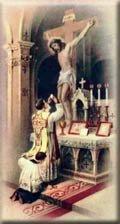
"The crucifix has been
called the 'principal ornament of the altar'
and is 'placed on the altar to [remind] the celebrant
and the people that the Victim [Christ] offered on the altar is the same as
was offered on the Cross' (Catholic Encyclopedia). The placement of the
crucifix on the altar is a requirement of the Traditional Latin ['Tridentine'] Mass" |
Often
no (if there is one, it is generally not visible to the priest who
may have his back to it) |
|
Decorating
& Incensing of Altar |
Yes
/ Yes (High Mass) |
Often
not / Usually not
"Protestants want to get
rid of the 'superstitions opinions of the popish
Mass' and get rid of the altar - which is the focal
point of the Mass. Protestants want a table which is used to eat
upon. The altar has always been given high reverence and dignity
by Catholics as it
represents the Lord Himself. Attached to it were the strictest
regulations concerning construction, cloths, etc. No expense was spared for beauty -
and even the poorest people were very generous -
so that it would be worthy of the sacred action which occurs at
Mass. There were relics of martyrs (cf. Rv. 6:9),
and various regulations were in effect, each of which took in to
account the fact that it is a most sacred
place - 'the place where heaven and earth meet'. After the Second
Vatican Council, these
regulations have been overthrown. The altar may no longer be elevated. Generally
there
is no incensing the altar. There
are greatly reduced requirements for
decoration of the altar and reduced symbolism. There
is no clear sense of its great
worth. In fact, altars that were works of art were thoughtlessly
destroyed. Is it any surprise that belief in the Real Presence has
diminished?" (Source: Davies)
|
|
'Destroyed
Old Rite'? |
No |
Yes
"English translations
have contained hundreds of glaring errors (many may be said to further
ecumenism).
One editorial in the 1960's even stated that
'The ancient and venerable text of
the Roman Canon has been mutilated beyond recognition.'"
"Indeed it is impossible
not to see the destruction of the Roman Rite as the greatest
triumph of Satan since the Protestant 'Reformation' - and it appears
that the Father of Lies is running out of ideas as he is making
precisely the same changes now as he did then." (Davies)
Note: Thankfully, however,
the old rite has not actually been 'destroyed', but remains as a
valid option for Catholics throughout the world. Click
here for more information on the status of the 'Tridentine'
Mass.
|
|
Diminished
Role of Priest? |
No |
Yes
"A good number of changes
incorporated into the 1965 Missal diminish the unique role of the
celebrant, particularly in sung Masses. He no longer says quietly
those parts of the Proper that are sung by the choir or the
people. Thus when the Introit is sung the priest does not recite
it after the prayers at the foot of the altar. The celebrant has
the option of singing or saying the parts of the ordinary said or
sung by the choir or the people with the choir or the people, as
if he were simply a member of the congregation, rather than saying
them separately sotto voce. Note how this diminution of the
distinct role of the celebrant is developed in the 1969 Ordo
Missae - where, for example, he is deprived of his separate
Confiteor and is just one of the brothers and sisters who confess
their sins." (Davies)
Note: Also consider that the
role of the priest is diminished by the use of lay readers, lay
'ministers', 'lay committees', etc. During Mass, he often sits in
the "presider's chair" while the laity 'take charge'.
|
|
Attempts
to Give Due
Respect & Honor to Almighty God? |
Yes
(as far as humanly possible)
|
Does
not appear to (especially considering Communion in the hand,
elimination of all signs of reverence, shift from focus on God to
the community, etc. ) |
|
Clearly
Adoration and Supplication of God? |
Yes |
Often
No
|
|
Clear
Sense of the Sacred? |
Yes |
Usually
No |
|
Sacrifice
of the Mass Sometimes 'Trivialized'? |
No |
Maybe
(especially the sacrificial element)
|
|
Ease
of Focus at Mass |
Easy |
Much
more difficult Note: Persons
are often distracted away from parts of the Mass by the music, the
noise, etc. |
|
Ease
of Adoration |
Easy |
Usually
difficult Note: In fact, precisely
when Christ is on the altar, the laity are often
effectively encouraged to ignore Christ and focus on their neighbors
(at the 'sign of
peace') |
|
Emphasis
on Real Presence? |
Yes |
No
|
|
Danger
of Equating the Real Presence of Christ with the 'Mystical
Presence'? |
No |
Yes
"Many readers will be
shocked to learn that the American hierarchy is actually preparing
the way for Catholic acceptance of the concept that the sacrifice
in the Mass is that of Christ being offered in virtue of His
presence in the congregation who offer themselves [a Protestant
concept]. In the official Newsletter of the Bishops' Committee on
Liturgy, a ruling was laid down that when distributing Holy
Communion a priest must not say: 'Receive the Body of Christ' or
'This is the Body of Christ.' The reason given is that the
congregation itself is the Body of Christ." (Davies)
|
|
Charged
With "Excessive Optimism" / Apparent Forgetfulness of Concupiscence? |
No |
Yes |
|
Explicitly
Sacrificial Prayers |
Yes |
Removed Note:
The removed prayers tend to parallel those removed by the
Protestant 'Reformers' of the 16th century. |
|
Externals
Bring Home Truths? |
Yes
Note: In the traditional Mass,
one's senses bring home Catholic
truths (e.g. the Real Presence, the Majesty of God, our dependence
on God, etc.), especially from the external signs of reverence
(e.g. bows, kisses, genuflections, signs of the cross, candles, incensing
of the altar, etc.) |
No Note:
In fact, the externals of a Novus Ordo Mass encourage one's senses to actually battle
against what one knows to be true (e.g. when one knows the truth
of the Real Presence but sees the Holy Eucharist being treated
like ordinary bread). |
|
Facilitates
Our Purpose in Life? |
Greatly
facilitates
"Man was created to
praise and adore the Lord his God, and in serving Him to save
himself. This is his end." (St. Ignatius Loyola)
"By the 'end of
man' we man the purpose for which he was created: namely, to
know, love, and serve God." (Baltimore Catechism)
|
Less
facilitation |
|
Faithful
Reflection of Traditional Catholic Doctrine? |
Yes
|
As
a whole, may appear to be a less faithful reflection of doctrine (e.g. reduced
references to sin, hell, judgment, souls in purgatory, the Blessed
Virgin Mary, saints, the Mass as a sacrifice, etc.) |
|
Fixed
Canon? |
Yes
"And since it is fitting
that holy things be administered in a holy manner, and this
sacrifice is of all things the most holy, the Catholic Church,
that it might be worthily and reverently offered and received,
instituted the sacred canon many centuries ago, so free from all
error, that it contains nothing in it which does not especially
diffuse a certain sanctity and piety and raise up to God the minds
of those who offer it. For this consists both of the words of God,
and of the traditions of the apostles, and also of pious
instructions of the holy Pontiffs." (Council of Trent, 1562
A.D.) |
No
"The very idea that new
Eucharistic Prayers were needed to enter into 'free competition'
with the Roman Canon must send a shudder of horror through anyone
imbued with a trace of true Catholic pietas, who still thinks with
the mind of the Church - sentire cum ecclesia... Our canon is the
most venerable prayer in use in any liturgy." (Davies)
|
|
Focus
on Honor Paid to God? |
Yes |
No
Note: Mass often seems to be
about the people at the expense of God.
|
|
Focus
on Parish Community or 'Heavenly Community'? |
Heavenly
community |
Tends
to focus on the "accidental parish
community"
|
|
Fosters
a 'Spirit of Prayer'? |
Yes
"When a soul is continually being influenced by her contact with
the Church through the liturgy, it is impossible for the spirit of
prayer not to grow within her, and, either imperceptibly or
suddenly, produce in her a transformation into Him, who, being
God, has united Himself to our nature, in order that, through Him,
we might be united with God." (Liturgical Year) |
No
Note: In fact, personal prayer
during Mass is often discouraged or nearly impossible (e.g. due to noise,
distractions, loud music, inability to kneel, etc.).
|
|
May
Give the Impression to Outside Observers That We Think God is Our
"Equal"? |
No
Note: It is clear in the
Traditional Mass that God is our superior and that an infinite
distance separates us. |
Possibly
yes (or at least that the distance between us and God is slight or
less than infinite - especially due to lack of kneeling, Communion
in the Hand, 'presumed salvation of all present', etc.)
|
|
God
Focused / Community Focused |
God
focused |
Community
focused |
|
Guitars
& Drums? |
No |
Yes |
|
Mass
as Our Heritage |
Yes
Note: The 'Tridentine' Mass
was passed on to us and will - God permitting - continue to be
passed on as a precious heritage to future generations |
No
Note: The Novus Ordo Mass is
subject to continual change and therefore does not provide us any
heritage to pass on to our
children |
|
Holiness
of Mass is Apparent, Even to An Outside Observer? |
Yes
"Holy things, it cannot
be too often repeated, should be treated holily and with due
reverence." (Catechism of the Council of Trent)
"The perfection of
religion is to imitate whom you adore." (St. Augustine,
Doctor of the Church)
Reminder: The Eucharist is the
most holy of all the Sacraments. "But if we consider the dignity of the Sacraments, the
Eucharist, for holiness and for the number and greatness of its
mysteries, is far superior to all the rest." (Catechism of
the Council of Trent)
|
No
Note: Some Masses are so
irreverent that it is hard to imagine anyone - even non-believers -
consider them to be conducted in a holy manner.
|
|
Inaccuracies
in Creed? |
No |
Yes
Note: The text of the Creed
has been wrongly translated for years as "We believe"
instead of "I believe". Praying using the plural
"we" means that each is professing faith for others - even if those
around us are heretics! Note:
It is expected that the incorrect translation of the above into
"we" instead of "I" will be corrected in
upcoming translations. However the fact remains that this prayer has
been mistranslated for decades (even though the mistranslation was
well known).
|
|
Changed
Formula of Consecration? |
No |
Yes
Note:
Not only is the formula different, but the entire consecration is
recited as part of a narrative (the "Institution
Narrative"). Further, the consecration is no
longer highlighted with special typography (e.g. no large letters,
no capitals, no red ink, etc.) or marked off, but instead is
"apparently part of a historical context". Especially it
should be noted that when the consecration is part of a narrative,
there is a greater danger of invalid consecrations - if a priest
recites the prayer as a mere narrative, his intention may
be defective, resulting in no consecration whatsoever (for
a valid consecration, the priest must have the desire to
consecrate in the here and now, and not merely read about Our
Lord's past actions). |
|
Inaccuracy
in Formula of Consecration? |
No |
Yes
(the formula of consecration has been wrongly translated as
"for all" instead of "for many" for years) Note:
It is expected that the incorrect translation of "for many" will be corrected in
upcoming translations. However the fact remains that the formula
used for consecration has been mistranslated for decades (even though the mistranslation was
well known). |
|
Focus
on Interior or Exterior Participation? |
Interior
"[T]he chief element of
divine worship must be interior." (Pope Pius XII,
"Mediator Dei", 1947)
|
Exterior Note:
"The Mass was changed from interior
participation to exterior participation. But what exterior
participation can we really provide - the sacrifice is completed
by the priest alone. Interior participation is personal, exterior
is not - it's mechanical" |
|
Lay
Processions?
|
No |
Yes
[including both before and after Mass as well during Mass (the
'bringing up of the gifts')] |
|
'Extraordinary
Ministers'?
Note:
Click
here for more on this topic |
No
"To touch the sacred
species and to distribute them with their own hands is a privilege
of the ordained" (Pope John Paul II, 1980 A.D.)
"To safeguard in every
possible way the dignity of so august a Sacrament, not only is the
power of its administration entrusted exclusively to priests, but
the Church has also prohibited by law any but consecrated persons,
unless some case of great necessity intervene, to dare handle or
touch the sacred vessels, the linen, or other instruments
necessary to its completion. Priests themselves and the rest of
the faithful may hence understand how great should be the piety
and holiness of those who approach to consecrate, administer or
receive the Eucharist." (Catechism of the Council of Trent)
"The dispensing of
Christ's body belongs to the priest for three reasons. First,
because...he consecrates as in the person of Christ. But as Christ
consecrated His body at the supper, so also He gave it to others
to be partaken of by them. Accordingly, as the consecration of
Christ's body belongs to the priest, so likewise does the
dispensing belong to him. Secondly, because the priest is the
appointed intermediary between God and the people; hence as it
belongs to him to offer the people's gifts to God, so it belongs
to him to deliver consecrated gifts to the people. Thirdly,
because out of reverence towards this sacrament, nothing touches
it, but what is consecrated; hence the corporal and the chalice
are consecrated, and likewise the priest's hands, for touching
this sacrament. Hence it is not lawful for anyone else to touch it
except from necessity, for instance, if it were to fall upon the
ground, or else in some other case of urgency." (St. Thomas
Aquinas, Doctor of the Church and "greatest theologian in the
history of the Church")
"It must be taught, then,
that to priests alone has been given power to consecrate and
administer to the faithful, the Holy Eucharist. That this has been
the unvarying practice of the Church, that the faithful should
receive the Sacrament from the priests, and that the officiating
priests should communicate themselves, has been explained by the
holy Council of Trent, which has also shown that this practice, as
having proceeded from Apostolic tradition, is to be religiously
retained, particularly as Christ the Lord has left us an
illustrious example thereof, having consecrated His own most
sacred body, and given it to the Apostles with His own
hands." (Catechism of the Council of Trent)
"[L]aymen are officially
incompetent to dispense any sacrament: and that they can baptize
in cases of necessity, is due to the Divine dispensation, in order
that no one may be deprived of spiritual regeneration." (St.
Thomas Aquinas, Doctor of the Church and "greatest theologian
in the history of the Church") |
Yes
Note: The use of so-called
'Extraordinary Ministers of the Eucharist'+ (also wrongly, but
popularly called "Eucharistic Ministers") - lay persons (including
women) distributing Holy Communion - began in the 20th century as
a result of disobedience to the Pope. Their use, in the wake of
the Second Vatican Council, has contributed to irreverence, loss
of faith, confusion of the priestly role, desecration, and
sacrilege. Their use is an entire break with Catholic tradition,
and it coincides with Protestant sensibilities. The use of lay
"Ministers of Holy Communion" is problematic for many
reasons including the following:
*
Leads to additional handling of the Holy Eucharist (two additional
people may now touch It - the lay 'minister' and the communicant)
and therefore there is greater danger of spillage, profanation,
and sacrilege
*
Diminishes respect for the Holy Eucharist
*
Diminishes respect for the priesthood by placing lay persons on
the same level as priests
*
Leads to loss of faith in the Real Presence
*
Is a manifest rejection of tradition. Note that the practice of
'lay administered Communion' during Mass has no historical
precedent whatsoever (remember that even if the apostles
'self-communicated' they were bishops - not lay persons).
*
Is traced to acts of disobedience to the Pope
*
Leads to 'self-communication' (the recipient may put the Holy
Eucharist in his own mouth). Note: Click
here for more on this topic
*
Reduces reverence and creates distractions
*
Has been condemned by popes and saints
*
Has been used as a tool by liberals and feminists who want to
change the Church
*
Is often used where it is prohibited - and becomes the de facto
"norm" rather than an "extraordinary"
occurrence
*
Is especially scandalous given the poor behavior, immodest dress,
and bad example of some 'extraordinary ministers'
*
Conforms to Protestant sensibilities - heretics who reject the
Real Presence and the hierarchical priesthood *
Leads to the deplorable situation of Holy Communion being taken to
the sick by lay persons - thereby depriving the sick of the
presence of the priest & the other sacraments in their
critical hour of need - possibly leading to the loss of eternal
souls! Note: For more information on this topic, click
here. Women
should especially consider that the use of 'lay ministers' is used
as a tool to advance a feminist agenda, which is contrary to the
will of God [Click
here for 'Top Reasons Why Women Can't Be Priests'. Click
here for 'Proper Role & Behavior of Women' (Priests &
Vocations Reflections)]. Note that the Church - in accordance with
Holy Scripture - has always rejected certain roles for women as
improper. +
Reminder: The correct term for such 'lay ministers' is
"Extraordinary Ministers of Holy Communion" (NOT
'Eucharistic Ministers' and NOT 'Extraordinary Ministers of
the Eucharist') |
|
'Liturgical
Pluralism'? |
No |
Yes
(except for the Traditional Mass)
"It must however, be recognized
that with a new liturgy that varies so much according to national
tastes as to make the way it is celebrated in one country
unrecognizable to Catholics from another, and when a rite in one
language, of one heart and mind, has been replaced by a rite
lacking all these qualities, it was an affront to the much vaunted
principle of liturgical pluralism that the traditional rite of
Mass should be the one thing that was not allowed" (Amerio)
|
|
Mass
is Clearly the Center of Christian Piety? |
Yes
(and it also helps to foster piety)
"The Mass is the chief
act of divine worship; it should also be the source and center of
Christian piety." (Pope Pius XII, "Mediator Dei",
1947 A.D.)
|
Much
less clear (and it may even discourage personal piety - e.g.
kneeling, personal prayer, etc.) |
|
Mass
is Useful For Combating Protestant Heresies? |
Yes
|
No |
|
'Nationalization'
of Liturgy? |
No
"[T]he Sacred Liturgy expresses
and celebrates the one faith professed by all and, being the
heritage of the whole Church, cannot be determined by local
Churches in isolation from the universal Church" (Pope John
Paul II, 2003 A.D.)
|
Yes
Note: While the old mass
prevented nationalization and individualism, the new Mass seems to
embrace these concepts. In doing so, the various (new) Masses may
"give off different meanings, some may contradict or appear to
contradict Church dogmas - and will change with each Mass, turning
them into expressions of our own views"
|
|
Clearly
Observes Hierarchical Order? |
Yes
|
No
"It has come to the attention
of the holy and great council that in some localities and cities
deacons give the Eucharist to presbyters, although neither the
canon nor the custom permits those who do not offer sacrifice to
give the Body of Christ to those who do not offer the sacrifice.
This, too, has become known: that some deacons are now receiving
the Eucharist even before the bishop. All this is to be
discontinued, and the deacons are to be kept within their own
proper bounds, knowing that they are the servants of the bishop
and that they are less than presbyters [priests]. They are to receive the
Eucharist, in accord with their rank, after the presbyters, either
a bishop or a presbyter giving it to them. And neither are the
deacons permitted to sit among the presbyters; for this is
contrary to rule and order. If anyone, after these directives,
still does not tender his obedience, he is to be deposed from the
diaconate." (First Council of Nicaea, 325 A.D.) |
|
Omission
of Elements Offensive to Protestants? |
No |
Yes
Note: In fact, the elements
omitted from the New Mass parallel those omitted by Protestants in
the 16th century. "The sound and invariable
practice of the Church in the West was breached for the first time
by the sixteenth-century Protestant 'Reformers'. They broke with the
tradition of the Church by the very fact of initiating a drastic
reform of liturgical rites, and this would still have been the
case even had their reformed liturgies been orthodox. The nature
of their heresy was made clear not so much by what their rites
contained as by what they omitted from the traditional books."
(Davies) As Fr. Bugnini, architect of the new Mass, has admitted,
"[it was necessary] to push aside any stone that could
constitute even a shadow of a risk of stumbling or of displeasure
for our separated brethren."
|
|
Obstacle
to 'One World Religion'? |
Yes |
No
In the Novus Ordo
there has
been an "'unbelievable convergence' in liturgical
practices between Catholics and Anglicans." (Source: Davies)
"Just how close [the Novus Ordo Missae] has now come [to
Protestant services] was made
clear by [a Protestant] in a lecture delivered at London Colney,
Herts, on 11 November 1974. He spoke enthusiastically of a Mass which he had attended containing virtually nothing with which he,
as an evangelical, could disagree but for one phrase in the
Thanksgiving Prayer (Canon). He knew, however, that many of his
Roman Catholic colleagues did not mean by it what they actually
say - 'they may say it but they don't actually mean it, so they
assure me.' He went on to add that anyone who did a little
research would find that the common ground between Series III
[Protestant liturgy] and
the new Mass is the liturgy of the 'Church of South India' - though
neither 'Church' seemed keen to admit this! (The 'Church of South
India' was formed by uniting Anglicans and 'Free Churches' into one
body. It resulted in a good number of Anglican clergymen becoming
Catholics as they correctly interpreted this step as incompatible
with Anglican claims to apostolic orders...)" (Davies)
"Facts have now emerged
which provide an even more disquieting aspect to the unprecedented
phenomenon of Protestants being asked to help
compile a new Catholic Mass. There is evidence of a concerted
scheme for different denominations to reform their respective
liturgies in the direction of an eventual united Christian rite.
This becomes clear simply by examining the text of the new
Anglican Series III Communion Service. Material not found in the
Roman Mass or the Anglican Prayer Book has suddenly found its way
in to the revised rites of both communions. The celebrant is
referred to as the President, there are Bidding prayers and a
'sign of peace'; after the Consecration the congregation says
'Christ has died, Christ has risen, Christ will come again.' After
the Our Father, the following appears: 'For the kingdom, the
power, and the glory are yours now and forever.' No rational
person could brush this evidence aside as mere coincidence,
particularly in view of the fact that an Anglican observer on the
Consilium, Dr. Jasper, played a leading part in the compilation of
the Series III service. It is hardly surprising that another
Anglican 'minister' was able to write to the London Catholic Herald,
stating: 'Today's liturgical study has brought our respective
liturgies to a remarkable similarity, so that there is very little
difference in the sacrificial phrasing of the prayer of oblation
in the Series Three and that of the Eucharistic Prayer II in the
Missa Normativa.' The Anglican 'bishop' of Southwark has stated on
several occasions that he greatly admires the Novus Ordo Missae,
uses it himself, and would like to see it generally available to
Anglicans at least as an alternative. He has also 'con-celebrated'
Mass with Catholic priests when traveling on the continent!"
(Davies)
|
|
Ongoing
Change? |
No |
Yes
Note: Since the Mass is no
longer perceived as fixed, the "liturgical revolution"
may continue unabated unless it is reigned in by Church
authorities.
|
|
Perceived
Focal Point of Mass |
Consecration "As for the people, it is abundantly possible for them
to understand and follow the Mass without either knowing Latin or
possessing minute knowledge of the ceremonies. The Mass has broad
features, which are easily brought within the comprehension of the
least cultivated minds. It is easy to make the faithful realize
what is the central point of the Mass - the consecration of Our
Lord's Body and Blood." (Bishop
Hedley) |
"Sign
of Peace"
Note: Sadly, many people think
the 'sign of peace' is the focal point of Mass. Note: Click
here for more information on this topic.
|
|
Placement
of Faithful in Relation to God |
Emphasizes
the faithful's clear dependence on God
|
Oftentimes
appears to place the faithful as equals (e.g. Communion in the
hand) or at least appears to consider the distance between the faithful and God
as much less than
infinite |
|
Clearly
Places God First? |
Yes |
No Note:
Although it is easy to say "Praise God", it is not that
easy to follow His commands. As Jesus has said, "If you love
me, you will keep my commandments" (Jn. 14:15) In the Novus Ordo
Mass, it is much less clear that it is necessary to keep these
commands in order to save our souls since God's great mercy seems to be overemphasized
at the expense of God's fearful justice. Since God
wishes to be worshipped "in spirit and truth" (Jn.
4:24),
it would seem wrong to simply say "Praise God", when one
has no intention of doing all that is necessary to keep His
commands. Remember that "Not everyone who says to me, 'Lord, Lord,' will enter the kingdom of heaven, but only the one who does the will of my Father in heaven."
(Our Lord Jesus Christ, Mt. 7:21) |
|
Prayerful
Atmosphere? |
Yes
"It is written, 'My house
shall be a house of prayer" (Our Lord Jesus Christ, Lk.
19:46) |
No
Note: Whereas the 'Tridentine'
Mass offers a the faithful a reverent, prayerful atmosphere, the
Novus Ordo Mass almost never produces an atmosphere conducive to
personal prayer. In fact, it can be nearly impossible to offer
personal prayers at certain times during the Mass (and even before
and after Mass) due to the constant chatting, noise, loud music, frequent
distractions, proscriptions against kneeing, etc. And, in
some cases, personal prayer may even be explicitly discouraged
during Mass.
|
|
Priests'
Apparent "First Concern" |
Salvation
of souls
|
Social
issues Note: Priests should
first concern themselves with the salvation of souls rather than
social work. "If the
priest isn't focusing on holiness, where does that leave us?" |
|
Willingness
of Priests to Speak About 'Hard Truths' |
Far
more
willing |
Much
less willing
Note: In the past, priests spoke about hell,
judgment, sin, purgatory, sin, etc. Nowdays, priests often shy away from such topics, as if they were no longer
Catholic dogma.
|
|
Widespread,
Well-Proven Fruits? |
Yes
Note: If nothing else, the
long list of saints showed the excellent fruits of the old Mass.
However, many other good fruits have also been apparent (e.g.
widespread faith, orthodoxy of attendees, large number of
vocations, etc.)
|
No.
In fact, many poor fruits have resulted.* * Note:
This refers to the new rite as compared to the old rite, of
course, and does not in any way refer to the Sacrament, which is
the same in both Masses |
|
Clear
Realization That We Are Sinners Standing in God's Presence? |
Yes
|
No |
|
Use
of Words That Protestants Reject |
Yes |
Deleted
/ Reduced
Note: The New Rite of Mass
deleted many words and concepts - and even entire prayers - that
Protestants reject. Deleted items include: invocations to the
Blessed Virgin Mary and to saints and to angels, references to
purgatory, references to a propitiatory sacrifice, references to
the hierarchical priesthood, etc. |
|
Sacrifice
/ Memorial |
Sacrifice
|
Memorial
Note: Rather than considering
Mass as a "propitiatory,
sacrificial act by a priest acting 'in persona Christi'"- the
true Catholic doctrine - there is an attempt to consider the Mass
as a mere memorial. As Amerio
has stated, "We are not commanded to remember
what Christ has done, but rather to do the same thing that Christ
did and to do it to remember." |
|
Effective
Liturgical Safeguards Protect From Abuse? |
Yes
"No wonder, then, that
the Roman Pontiffs have been so solicitous to safeguard and
protect the liturgy. They have used the same care in making laws
for the regulation of the liturgy, in preserving it from
adulteration, as they have in giving accurate expression to the
dogmas of the faith." (Pope Pius XI, "Divini Cultus",
1928 A.D.)
|
No Note:
"If one thing has been consistent in the New Rite of Mass,
it's liturgical abuse." At times this abuse is so serious as
to call the validity of the Sacrament into doubt, or even completely
to invalidate the Sacrament. In fact, in some locations
invalid sacraments have continued for years. |
|
Widespread
Abuses Have Necessitated Papal Intervention? |
No |
Yes |
|
Secular
Music? |
No
"[Sacred music] must be
holy. It must not allow within itself anything that savors of the
profane [i.e. that which is not sacred] nor allow any such thing
to slip into the melodies in which it is expressed." (Pope
Pius XII, "Musicae Sacrae", 1955 A.D.) |
Maybe
|
|
Society
Borrows From Liturgy? |
Yes
|
No
"Anyone who reads [certain writings] will be amazed at the
knowledge people of the lowest classes had of the formulas and ceremonies of the liturgy, not always of
course properly used, and often bearing a twisted meaning, but
attesting nonetheless the influence the Church's rites had on the
popular mind. Today such influence has entirely vanished, and
popular speech takes its style from anything rather than the
liturgy, especially from sport. The reform is an important
linguistic phenomenon that has changed the ritual language of a
half a billion people and has removed the last traces of
liturgical influence upon ordinary speech." (Amerio) |
|
Rite
of Mass Has Inspired Great Works of Art?
Note:
This refers to the rites themselves, of course, and not to the
Sacrament, which is the same in both Masses |
Yes
(it has inspired artists, musicians, poets, etc. throughout many
centuries) |
None
known
|
|
Treated
As the Most Sacred Thing on Earth? |
Yes
|
No "The Mass is the holiest thing on earth and should be treated as
such. If we treat the holiest thing on earth with little respect,
not only do we offend God, but what can we hope for for lesser
things?" |
|
Seasons |
More
seasons, more instructive names |
Fewer
seasons, less instructive names (e.g. "Ordinary Time"
vs. "Time After Pentecost") |
|
Preparation
For Lent |
Three
weeks of preparation |
Minimal/no preparation |
|
Unanimity
in the Transmission of Doctrine? |
Yes
|
No Note:
Although the Church alone maintains true doctrine, if it is
presented in different ways, it may be subject to various
interpretations, possibly even leading to the loss of souls (e.g.
if truths that must be believed are not believed or if mortal sins
are not given sufficient consideration, etc.) |
|
Clear
that the Holy Eucharist is the Supreme Object of Our Worship? |
Yes
"The Blessed Sacrament is
the first and supreme object of our worship." (St. Mary
Euphrasia Pelletier)
|
No |
|
Holy
Eucharist Given the Highest Degree of Veneration / Adoration? |
Yes
"Our love for the Blessed
Sacrament should be carried to the highest degree"
(St. Mary Euphrasia Pelletier)
|
Often
not (in fact, many people even turn their back on the Holy
Eucharist during the 'sign of peace', and then proceed to receive
Holy Communion, standing, from a lay person, and with unwashed
hands) |
|
Clear
Differences Between Rites Among Adjacent Regions? |
No |
Yes
(in fact, sometimes even in the same parish!)
"As far as possible, notable
differences between the rites used in adjacent regions should be
avoided." (Second Vatican Council, 12/4/1963)
|
|
Overthrow
of Canon of the Mass? |
No |
Yes
(although after some controversy a
modified version of it was added as an option, albeit
rarely used)
Note: "The Council of Trent
anathematized anyone who alleged that the Canon contained errors
or should be done away with." (Davies)
|
|
Irreverent
Reception of Holy Communion |
"Almost
never" |
Very
common
"If it is not becoming
for anyone to approach any of the sacred functions except
solemnly, certainly, the more the holiness and the divinity of
this heavenly sacrament is understood by a Christian, the more
diligently ought he to take heed lest he approach to receive it
without great reverence and holiness, especially when we read in
the Apostle those words full of terror: 'He that eateth and
drinketh unworthily, eateth and drinketh judgment to himself not
discerning the body of the Lord' [1 Cor. 11:29]." (Council of
Trent, 1551 A.D.)
|
|
Faithful
Know Not To Approach Holy Communion Without Proper Dispositions / State
of Grace? |
Yes |
Often
(apparently) not |
|
Rite
Receives High Praise? |
Yes |
No
(except from liberals, feminists, Protestants, etc.)
"There is no living priest who
can speak with greater authority concerning the liturgical
movement and the Liturgy Constitution of Vatican II than Fr. Louis
Bouyer. He gave the
[Second Vatican Council's] Constitution a rapturous welcome in his book...
praising it as the culmination of the movement - and yet now he
condemns the reform which has been imposed as a deliberate turning
of the back upon both. There is, he claims, no liturgy worthy of
the name in the Catholic Church today [note that this was before the
Traditional Latin Mass was
'brought back to widespread public use (click
here)]" (Davies)
|
|
Reason
Rite of Mass was Codified / Imposed |
Mass
was codified to combat heresy, to offer the most fitting worship
to God, to raise the mind to God, to help save souls, etc. |
Mass
seems primarily imposed to please Protestants and to make
'worship' more agreeable to 'modern man'. |
|
"Cognitive
Dissonance"? |
No
Note: In the 'Tridentine'
Mass, all elements correspond to the truth of Catholic dogma and
create no internal discord. |
Yes
Note: A well catechized
Catholic may find that there is great discord between what one
knows to be Catholic dogma and what sees occurring in Mass (e.g.
knowing the truth of the Real Presence but seeing the Holy
Eucharist treated like simple bread). |
|
Parishioners
Customarily Pray Before Mass? |
Yes |
Often
not - instead they may talk, walk around, socialize, greet others,
etc., making it almost impossible for others to pray. |
|
Priest
Leads Prayers After Mass? |
Usually yes
(Low Mass) Note: The "Leonine
prayers" have been said for various intentions and are not part of
Mass itself. |
No |
|
Capitalization
of the Word 'Catholic' in the Missal(ette) |
In
English, usually appears capitalized |
In
English, often appears in lower case letters |
|
Certain
Songs / Responses Often Unusually Elongated by the Choir? |
No |
Often
certain songs are so elongated by the choir as to (1) shift the
emphasis of the Mass to individualistic concerns, or (2) to appear
to give excessive importance to a particular part of Mass
(relatively speaking), or (3) distract others from interior
prayer, or (4) to make the singing almost appear to be a musical
production or entertainment. Some music that may typically be
elongated includes:
*
Response: "Lord hear our prayer"
*
Holy, holy Lord (may take a very long time to complete)
*
Amen (this single word alone may appear to take minutes to sing! - "Aaaaay-men,
aaaaay-men, Aaaaaaaaaaaaaa -men")
|
|
Missal
vs. Missalette |
Missal |
"Missalette"
Note: In contrast to the
'fixed' Missal as used in the 'Tridentine' Mass, the changeable
"missalettes" provided at many Novus Ordo Masses subject
readers to many novelties. They may surround the text with
"fluffy, feel-good" commentary, use capital letters
improperly (even for significant words),
detract from the Mass as a sacrifice, etc. Since they are not
fixed in nature, and tend to change so frequently, they do not
protect persons from liturgical abuse as the old missals do (in
fact, they may even tend to promote various novelties). In especially
liberal parishes, they may discourage the use of a missal altogether,
in order that they may improvise during Mass. |