|
Now Available!
Catholic Word Search - JUMBO Edition
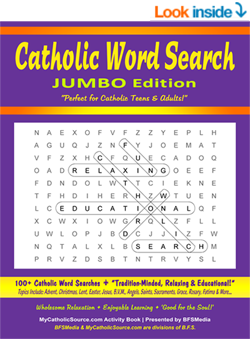
(Original)
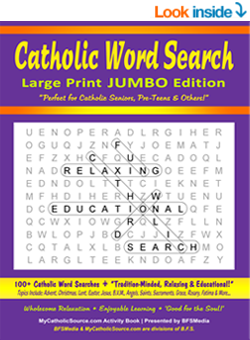
(Large Print Edition)
100+ Catholic Word Searches (Incl. Advent,
Christmas, Lent, Easter, Jesus, B.V.M., Angels, Saints, Sacraments, Grace, Rosary, Fatima, And More...)
"Relaxing, educational, good
for your memory, mind, focus, vocabulary, and good for your soul!"
Get Your Copy Today!
Also
Available...
Catholic
Word Search - Bilingual Edition: Latin / English
Search Words In Latin, Meanings In English
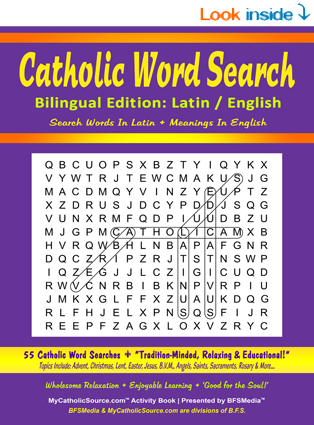
55 Catholic Word Searches ~ "Tradition-Minded,
Relaxing & Educational!"
Topics Include: Advent, Christmas, Lent,
Easter, Jesus, B.V.M., Angels, Saints, Sacraments, Rosary & More...
"Perfect For Catholic
Teens & Adults!" ~ "Great For Home Schoolers!"
Get Your Copy Today!
Why Latin? / Latin Info.
Click link or image above for more information & to purchase.
And...
Catholic
Word Search - Bilingual Edition: French / English
Search Words In French, Meanings In English
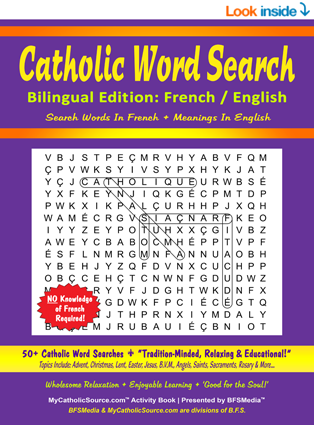
Absolutely NO Knowledge Of
French Is Required!
50+ Catholic Word Searches ~ "Tradition-Minded,
Relaxing & Educational!"
Topics Include: Advent, Christmas, Lent,
Easter, Jesus, B.V.M., Angels, Saints, Sacraments, Rosary & More...
"Perfect For Catholic Teens & Adults!" ~ "Great
For Home Schoolers!"
Fun for any time! Also great for...
* Planning a Catholic pilgrimage to France
* Learning some (or brushing up on some) French
words
* Increasing your French vocabulary
* Adding fun to a homeschool curriculum
* Enjoying a unique challenge, even if you
don't speak a word of French!
Free Sample Here
Get Your Copy Today!
Why Learn French?
Click link or image above for more information & to purchase.
Now Available!
4
Great Inspirational Catholic Coloring Books...
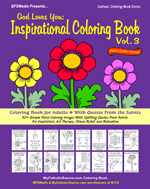
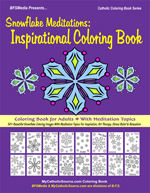
Plus These Handy Coloring Books & Resources...
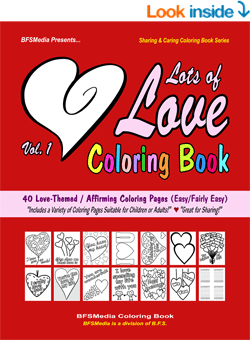
Lots of Love Coloring Book (Vol.1) - 40 Love-Themed / Affirming Coloring Pages (Easy/Fairly Easy) - "Includes a Variety of Coloring Pages Suitable for Children or Adults!" ~ "Great for Sharing!"
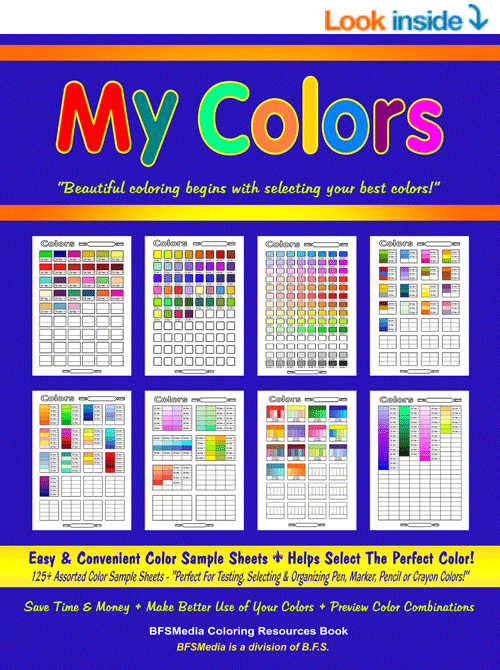
My Colors - Easy & Convenient Color Sample
Sheets ~ Coloring Resources Book: 125+ Assorted Color Sample Sheets - "Perfect
For Testing, Selecting & Organizing Pen, Marker, Pencil or Crayon Colors!"
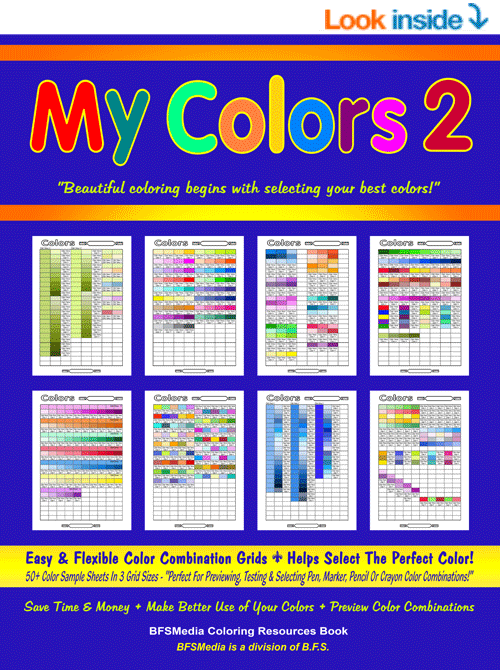
My Colors 2 - Easy & Flexible Color
Combination Grids ~ Coloring Resources Book: 50+ Color Sample Sheets In 3 Grid
Sizes - "Perfect For Previewing, Testing & Selecting Pen, Marker, Pencil Or
Crayon Color Combinations!"
[Please Note: Proceeds from sales of these books may support My Catholic Source.com]
For More Information & To
Purchase, Click Image(s) Above
Click Here For Coloring Examples
Now Available!
700+ Consoling Thoughts From Holy Scripture
"Inspirational & Uplifting!"
"Some of the most consoling
& comforting words from Holy Scripture, all in one place!"
+ + +
Compiled From Traditional Catholic Scripture
(Douay-Rheims Translation)
Get it today!
+ + +
For More Information & To
Purchase, Click Link Below...
Kindle Version Just $7.99
Notice: Prices are subject to change
without notice and do not include any applicable taxes.
Now Available!
The iStations Book - Stations of the Cross
Two Traditional Way of the
Cross Methods for Catholics Based on Our 'Best Selling' App
Features beautiful images, TWO traditional
methods, including a Franciscan method, selected prayers in English & Latin
Get it today!
For More Information & To
Purchase, Click Link Below...
Kindle Version Just $4.99
Notice: Prices are subject to change
without notice and do not include any applicable taxes.
Now Available!
Catholic Annual Prayer Book
Includes: 365+ Daily Prayers (Jan.-Dec.);
Holiday / Seasonal Prayers; Hundreds of Prayers Indexed by Title;
Nearly 200 Aspirations / Short Prayers; Over 100 Latin Prayers & Aspirations; 500+
Topics for Meditation; Hundreds of Prayer Tips & Insights; And More...
Includes prayers drawn from Holy Scripture, the
liturgy, writings of popes & saints, the Raccolta, the Roman Breviary, the Roman
Missal, etc.
A daily prayer companion for
Catholics that is 'suitable for any year'!
Kindle Version Just $8.99
Notice: Prices are subject to change
without notice and do not include any applicable taxes.
Click Here to Buy
Now Available!
Coloring Book For Catholics: 50+ Latin
Prayers
(Beginning - Intermediate - Advanced)
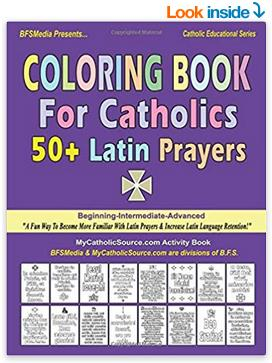
"This 'unique', tradition-minded coloring book
which contains some of the most popular Catholic prayers in Latin is a fun way
to become more familiar with Latin prayers & increase Latin language retention!"
This 'educational & fun' publication is useful
for prayerful relaxation, educational recreation ('learn while you play'),
becoming more familiar with Latin prayers & hundreds of Latin words, learning or
memorizing Latin prayers, increasing Latin retention, and more...
An enjoyable and
instructive tool with respect to Latin (the 'beautiful & majestic language of
heaven' and 'official language of the Church' - a language 'consecrated' by the
inscription on the Cross that helps to foster a universal bond in prayer with
Catholics around the world), this publication is suitable for Catholics of most any
age.
+ + +
"This Catholic coloring book
- which provides hours of wholesome & educational recreation - is so much better
for your soul than television!"
+ + +
Notice: Prices are subject to change
without notice and do not include any applicable taxes.
Click Here to Buy
Now Available!
My Little Latin Mass Coloring Book

25+ Traditional Latin Mass Coloring Images For Children Or Adults [Low
Mass]
"Enjoyable & Educational!"
+ + +
Notice: Prices are subject to change
without notice and do not include any applicable taxes.
Click Here to Buy
Catholic Classics Reprint Now Available!
In Heaven We Know Our Own - Or, Solace for
the Suffering
This 'Catholic Classic', which offers consoling
'proof' that the faithful departed remember, love & care for those in heaven and
for those still remaining on earth, is a "great balm of comfort" to those who
have lost a spouse, child, parent, friend, or other loved one. "A thoughtful
bereavement gift, and a 'must-have' for grieving Catholics!"
Get your copy today!
For More Information & To
Purchase, Click Link Below...
Kindle Version Just $2.99!
Notice: Prices are subject to change
without notice and do not include any applicable taxes.
Now Available!
Setting The Record Straight About Luther
Important Things Catholics Should Know About
The 'Reformer'
Don't miss this
'eye-opening' treatise concerning Martin Luther, the catalyst / leader of the
' Reformation ' (a.k.a. Protestant Rebellion)
Includes: Facts which demonstrate that Luther
was NOT sent by God, Luther received approval of his teaching from Satan,
Luther's misbehavior, some results of Luther's teachings, Luther admits he could
be wrong, and more...
Get your copy today!
For More Information & To
Purchase, Click Link Below...
Kindle Version Just $5.99
Notice: Prices are subject to change
without notice and do not include any applicable taxes.
Now Available!
BIG Book of Latin Activities For Catholics
Beginning - Intermediate (Vol. 1)
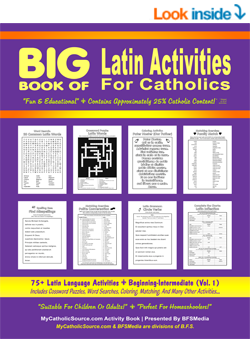
"Suitable For Children Or
Adults!" ~ "Perfect For Home Schoolers!"
+ + +
As many faithful Catholics already know,
the majestic
Latin language – the 'official language' of the Catholic Church –
promotes unity, helps safeguard the purity of doctrine, connects us with
our Catholic ancestors, allows us to pray in "one voice", and even ties
back to the inscription on the Cross which was written in Hebrew, Latin,
and Greek. The Latin language is still used today in the precious
treasure that is the
Traditional Latin ('Tridentine') Mass, in 'everyday speech' (much of
English is derived from Latin), in mottos, in specialized fields, and in
educational endeavors. It has been shown that the study of Latin brings
many benefits. "And, Latin is truly the language of heaven!"
If you enjoy Latin, you may be glad to know that
this full-sized (8.5" x 11"), tradition-minded publication features an
assortment of activity types related to Latin (including: word searches,
crosswords, coloring activities, challenges, fill-ins, spelling bee,
quizzes, unscrambles, true/false, multiple choice, matching, cross-offs,
circling, word associations, translation exercises, and more...), and
treats of various topics (including: common Latin words, Latin language
facts, Latin grammar, nouns & verbs, abbreviations,
phrases / sayings / mottos, prefixes, cardinal numbers, grammatical gender,
inflection, word roots, diacritics / accenting, pronunciation, Latin
prayers / hymns, Scripture verses, Catholic phrases, and more...).
+ + +
" Fun & Educational! "
Get Your Copy Today!
Click Here For More Information & To Purchase
Now Available!
Activity Books For Kindle Scribe

Write-On Books For Scribe!
Click Here For More Information
Try Here For Great Catholic Apps!

My Crucifix
For the iPad®, iPhone®,
and iPod touch®...

For the iPad®...


And Other Great Apps...



More My Catholic Source.com Media: Books & Ebooks
|