|
Reflections: Sacraments Sctn. (Holy Eucharist/Mass) |
|
 |
Return
to Sacraments Reflections | Sacraments Section
Reflections:
Sacraments Section:
Holy Eucharist / Mass
Wisdom of the Popes, Saints, Theologians, Other...
|
|
Important Notice: We
make no guarantees regarding any item herein. Use of site is subject to
our terms of use. By using this site you indicate agreement to all
terms. For more terms information, see below and
click here.
|
Click link below or scroll down to view all...
Category |
Quotation |
|
Eucharistic
Adoration / The Eucharist Reserved in the Tabernacle |
Click here for 'Reflections' related to this topic
Note:
Categories are subjective and may overlap. For more items related
to this topic, please review all applicable categories. For more
'Reflections' and for Scripture topics, see links below.
Top |
Reflctns.: A-Z | Catg.
| Scripture: A-Z |
Catg.
| Help
|
|
Forty
Hours Devotion
Also See:
Holy
Eucharist (Topic Page)
|
"It
was the pious Cardinal Gabriel Paleotti, archbishop of Bologna,
who first originated the admirable devotion of the Forty Hours. He
was a contemporary of St. Charles Borromeo, and, like him, was
eminent for his pastoral zeal. His object in this solemn
Exposition of the most blessed Sacrament was to offer the divine
Majesty some compensation for the sins of men, and, at the very
time when the world was busiest in deserving His anger, to appease
it by the sight of His own Son, the Mediator between heaven and
earth. St. Charles immediately introduced the devotion into his
own diocese and province. This was in the sixteenth century. Later
on, that is, in the eighteenth century, Prosper Lambertini was
archbishop of Bologna; he zealously continued the pious design of
his ancient predecessor Paleotti, by encouraging his flock to
devotion towards the blessed Sacrament during the three days of
carnival; and when he was made Pope, under the name of Benedict
XIV, he granted many Indulgences to all who, during these days,
should visit our Lord in this mystery of His love, and should pray
for the pardon of sinners. This favor was, at first, restricted
the faithful of the Papal States; but in the year 1765 it was
extended, by Pope Clement XIII, to the universal Church. Thus, the
Forty Hours' Devotion has spread throughout the whole world, and
become one of the most solemn expressions of Catholic piety. Let
us, then, who have the opportunity, profit by it... Let us, like Abraham,
retire from the distracting dangers of the world, and seek the
Lord our God. Let us go apart, for at least one short hour, for
the dissipation of earthly enjoyments, and, kneeling in the
presence of our Jesus, merit the grace to keep our hearts innocent
and detached..." (Dom
Gueranger)
Also
See: Eucharistic
Adoration / The Eucharist Reserved in the Tabernacle | The
Real Presence / Transubstantiation | Reverence
/ Proper Behavior (Mass / Holy Eucharist) | The
Holy Eucharist (Gen'l. Info.)
| Holy
Eucharist (Catechism of the Council of Trent)
| Proper
Behavior in Church | Mass /
Holy Eucharist Prayers | Prayers
& Devotions Section | Resources
| Holy
Eucharist (Topical Scripture) | Reverence
/ Honor to God (Topical Scripture)
Note:
Categories are subjective and may overlap. For more items related
to this topic, please review all applicable categories. For more
'Reflections' and for Scripture topics, see links below.
Top |
Reflctns.: A-Z | Catg.
| Scripture: A-Z |
Catg.
| Help
|
|
Holy Communion |
Click here for 'Reflections' related to this
topic, including:
Against
Communion in the Hand
Communion
of the Laity Under One Species
Frequent
Communion
Holy
Communion
Holy
Communion Should Be Denied to Those Who Obstinately Persist in Manifest
Grave Sin
The
Holy Eucharist Should Be Handled Only By Priests
Note:
Categories are subjective and may overlap. For more items related
to this topic, please review all applicable categories. For more
'Reflections' and for Scripture topics, see links below.
Top |
Reflctns.: A-Z | Catg.
| Scripture: A-Z |
Catg.
| Help
|
|
The Holy Eucharist
& The Goodness and Love of God |
Click here for 'Reflections' related to this topic
Note:
Categories are subjective and may overlap. For more items related
to this topic, please review all applicable categories. For more
'Reflections' and for Scripture topics, see links below.
Top |
Reflctns.: A-Z | Catg.
| Scripture: A-Z |
Catg.
| Help
|
|
Holy Eucharist /
Mass (Basics / Misc.) |
Click here for 'Reflections' related to this topic
Note:
Categories are subjective and may overlap. For more items related
to this topic, please review all applicable categories. For more
'Reflections' and for Scripture topics, see links below.
Top |
Reflctns.: A-Z | Catg.
| Scripture: A-Z |
Catg.
| Help
|
|
Holy Eucharist /
Mass & Priests |
Click here for 'Reflections' related to this topic
Note:
Categories are subjective and may overlap. For more items related
to this topic, please review all applicable categories. For more
'Reflections' and for Scripture topics, see links below.
Top |
Reflctns.: A-Z | Catg.
| Scripture: A-Z |
Catg.
| Help
|
|
Mass is a Sacrifice
/ The Mass & Calvary
Also See:
Holy
Sacrifice of the Mass (Topic Page)
Note: For More on This Topic, Try
Here (Holy Eucharist / Mass, Gen'l. Info.)
|
"The
Mass has just the same value as Calvary." (St. John
Chrysostom, Doctor of the Church)
"The
Mass makes present the sacrifice of the Cross; it does not add to
that sacrifice nor does it multiply it." (Pope John Paul II)
"In
the Mass there is offered to God a true sacrifice, properly
speaking, which is propitiatory for the living and the dead."
(Pope Pius IV)
"The
Mass is not an imitation, or a memory of Calvary, it is
identically the same sacrifice and differs only from Calvary in
appearance." (Fr. O'Sullivan)
"The
Eucharist is the perfect sacrament of our Lord's Passion, as
containing Christ crucified" (St. Thomas Aquinas, Doctor of
the Church and "greatest theologian in the history of the
Church")
"When
you hear Mass, do you come in the same frame of mind as the
Blessed Virgin at Calvary? Because it is the same God, and the
same Sacrifice." (St. John Vianney)
"If
any one saith that in the mass a true and proper sacrifice is not
offered to God; or that to be offered is nothing else but that
Christ is given us to eat; let him be anathema." (Council of
Trent)
"By
virtue of its close relationship to the sacrifice of Golgotha, the
Eucharist is a sacrifice in the strict sense, and not only in a
general way, as if it were simply a matter of Christ's offering
himself to the faithful as their spiritual food." (Pope John Paul II)
"The
Church constantly draws her life from the redeeming sacrifice [of
Christ]; she
approaches it not only through faith-filled remembrance, but also
through a real contact, since this sacrifice is made present ever
anew, sacramentally perpetuated [in the Mass]" (Pope John Paul II)
"There
is one Christ, not many offered by Christ and by us. For Christ
was offered once, and His sacrifice was the original of ours.
There is one body, not many, and so, wherever He is offered, the
sacrifice is one and the same with His." (St. Thomas Aquinas, Doctor of
the Church and "greatest theologian in the history of the
Church")
"[S]ince
the Sacrifice [of the Mass] is offered everywhere, are there, then, a
multiplicity of Christs? By no means! Christ is one everywhere. He
is complete here, complete there, one Body. And just as he is one
Body and not many though offered everywhere, so too there is one
Sacrifice." (St. John Chrysostom, Doctor of the Church, c. 403 A.D.)
"...death
has not destroyed this Body which was pierced with nails and
scourged…this is the Body which was once covered with blood,
pierced by a lance, from which issued saving fountains upon the
world, one of blood and the other of water…This Body He gave to
us to keep and eat, as a mark of His intense love." (St. John
Chrysostom, Doctor of the Church, 4th century A.D.)
"If
any one saith that the sacrifice of the mass is only a sacrifice
of praise and of thanksgiving; or that it is a bare commemoration
of the sacrifice consummated on the Cross, but not a propitiatory
sacrifice; or that it profits him only who receives; and that it
ought not to be offered for the living and for the dead for sins,
pains, satisfactions, and other necessities; let him be
anathema." (Council of Trent)
"'The
Lord Jesus on the night he was betrayed' (1 Cor. 11:23) instituted
the Eucharistic Sacrifice of his body and his blood. The words of
the Apostle Paul bring us back to the dramatic setting in which
the Eucharist was born. The Eucharist is indelibly marked by the
event of the Lord's passion and death, of which it is not only a
reminder but the sacramental re-presentation. It is the sacrifice
of the Cross perpetuated down the ages." (Pope John Paul II)
"And
thenceforth, the Apostles, and their successors in the priesthood,
began to lift to heaven that 'clean oblation' foretold by Malachy,
through which the name of God is great among the gentiles. And
now, that same oblation in every part of the world and at every
hour of the day and night, is offered and will continue to be
offered without interruption till the end of time: a true
sacrificial act, not merely symbolical, which has a real efficacy
unto the reconciliation of sinners with the Divine Majesty."
(Pope Pius XI, "Ad Catholici Sacerdotii", 1935 A.D.)
"They, therefore, err
from the path of truth who do not want to have Masses celebrated
unless the faithful communicate; and those are still more in error
who, in holding that it is altogether necessary for the faithful
to receive Holy Communion as well as the priest, put forward the
captious argument that here there is a question not of a sacrifice
merely, but of a sacrifice and a supper of brotherly union, and
consider the general communion of all present as the culminating
point of the whole celebration." (Pope Pius XII, "Mediator Dei", 1947
A.D.)
"I
wish to add something that is plainly awe-inspiring, but do not be
astonished or upset. This Sacrifice [of the Mass], no matter who offers it, be
Peter or Paul, is always the same as that which Christ gave His
disciples and which priests now offer: The offering of today is in
no way inferior to that which Christ offered, because it is not
men who sanctify the offering of today; it is the same Christ who
sanctified His own. For just as the words which God spoke are the
very same as those which the priest now speaks, so too the
oblation is the very same." (St. John Chrysostom, Doctor of
the Church)
"The august sacrifice of
the altar, then is no mere empty commemoration of the passion and
death of Jesus Christ, but a true and proper act of sacrifice,
whereby the High Priest [Christ] by an unbloody immolation offers Himself, a
most acceptable victim. to the Eternal Father, as He did upon the
cross. It is one and the same victim [Christ]; the same person now offers
it by the ministry of His priests, who then offered Himself on the
cross, the manner of offering alone being different. The priest is
the same, Jesus Christ, whose sacred Person His minister
represents." (Pope Pius XII, "Mediator Dei")
"The
Victim [Christ] alone saves the soul from eternal ruin, the sacrificing of
which presents to us in a mystical way the death of the
Only-begotten, who - though He is now risen from the dead and dies
no more, and death will no longer have dominion over Him, for He
lives immortally and incorruptibly in Himself - is immolated for
us again in this mystery of the sacred oblation. For His body is
eaten there, His flesh is distributed among the people unto
salvation, His blood is poured out, no longer in the hands of the
faithless but in the mouth of the faithful. Let us take thought,
therefore, of what this sacrifice means for us, which is [a] constant
re-presentation of the suffering of the Only begotten Son,
for the sake of our forgiveness." (Pope St. Gregory I the
Great, Doctor of the Church, 6th century A.D.)
"We
therefore confess that the Sacrifice of the Mass is and ought to
be considered one and the same Sacrifice as that of the cross, for
the victim is one and the same, namely, Christ our Lord, who
offered Himself, once only, a bloody Sacrifice on the altar of the
cross. The bloody and unbloody victim are not two, but one victim
only, whose Sacrifice is daily renewed in the Eucharist, in
obedience to the command of our Lord: Do this for a commemoration
of me. The priest is also one and the same, Christ the Lord; for
the ministers who offer [the Holy Sacrifice of the Mass], consecrate the holy mysteries,
not in their own person, but in that of Christ, as the words of
consecration itself show, for the priest does not say: This is the
body of Christ, but, This is my body; and thus, acting in the
Person of Christ the Lord, he changes the substance of the bread
and wine into the true substance of His body and blood."
(Catechism of the Council of Trent)
"The
august [Eucharistic] Sacrifice of the Altar is, as it were, the
supreme instrument whereby the merits won by the divine Redeemer
upon the cross are distributed to the faithful: 'as often as this
commemorative [Eucharistic] Sacrifice is offered, there is wrought
the work of our Redemption.' This, however, so far from lessening
the dignity of the actual sacrifice on Calvary, rather proclaims
and renders more manifest its greatness and its necessity, as the
Council of Trent declares. Its daily immolation reminds us that
there is no salvation except in the cross of our Lord Jesus Christ
and that God Himself wishes that there should be a continuation of
[Christ's sacrifice on the Cross] 'from the rising of the sun till the going down
thereof' (Mal. 1:11), so that there may be no cessation of the
hymn of praise and thanksgiving which man owes to God, seeing that
he required His help continually and has need of the Blood of the
Redeemer to remit sin which challenges God's justice." (Pope
Pius XII, "Mediator Dei", 1947 A.D.)
"And
forasmuch as, in this divine sacrifice which is celebrated in the
mass, that same Christ is contained and immolated in an unbloody
manner, who once offered Himself in a bloody manner on the altar
of the cross; the holy Synod teaches, that this sacrifice is truly
propitiatory and that by means thereof this is effected, that we
obtain mercy, and find grace in seasonable aid, if we draw nigh
unto God, contrite and penitent, with a sincere heart and upright
faith, with fear and reverence. For the Lord, appeased by the
oblation thereof, and granting the grace and gift of penitence,
forgives even heinous crimes and sins. For the victim [Christ] is one and
the same, the same now offering by the ministry of priests, who
then offered Himself on the cross, the manner alone of offering
being different." (Council of Trent, 1562 A.D.)
"This
sacrament is both a sacrifice and a sacrament. It has the nature
of a sacrifice inasmuch as it is offered up; and it has the nature
of a sacrament inasmuch as it is received. And therefore it has
the effect of a sacrament in the recipient, and the effect of a
sacrifice in the offerer, or in them for whom it is offered. If,
then, it be considered as a sacrament, it produces its effect in
two ways: first of all directly through the power of the
sacrament; secondly as by a kind of concomitance, as was said
above regarding what is contained in the sacrament (Q76,AA1,2).
Through the power of the sacrament it produces directly that
effect for which it was instituted. Now it was instituted not for
satisfaction, but for nourishing spiritually through union between
Christ and His members, as nourishment is united with the person
nourished. But because this union is the effect of charity, from
the fervor of which man obtains forgiveness, not only of guilt but
also of punishment, hence it is that as a consequence, and by
concomitance with the chief effect, man obtains forgiveness of the
punishment, not indeed of the entire punishment, but according to
the measure of his devotion and fervor. But in so far as it is a
sacrifice, it has a satisfactory power. Yet in satisfaction, the
affection of the offerer is weighed rather than the quantity of
the offering. Hence our Lord says (Mark 12:43; Luke 21:4) of the
widow who offered 'two mites' that she 'cast in more than all.'
Therefore, although this offering suffices of its own quantity to
satisfy for all punishment, yet it becomes satisfactory for them
for whom it is offered, or even for the offerers, according to the
measure of their devotion, and not for the whole punishment."
(St. Thomas Aquinas, Doctor of the Church and "greatest
theologian in the history of the Church")
Also
See: The
Holy Eucharist (Gen'l. Info.)
| Holy
Eucharist (Catechism of the Council of Trent)
| Holy
Eucharist / Mass (Basics / Misc.) | Holy
Eucharist / Mass & Priests | The
Holy Eucharist Should Be Handled Only By Priests | The
Real Presence / Transubstantiation | Reverence
/ Proper Behavior (Mass / Holy Eucharist) | The
Holy Eucharist (Classic Encyclicals) | Holy
Mass / Sacred Liturgy (Classic Encyclicals)
| Latin
Mass / Catholic Tradition | Latin
Mass / Catholic Tradition (Reflections)
| Church
Talk: 'Favorite Roman Catholic Churches'
| Church
Talk Reflections
| Proper
Behavior in Church | Holy
Eucharist (Topical Scripture) | Resources (Incl.
Printable Fliers) | Reverence
/ Honor to God (Topical Scripture)
Note:
Categories are subjective and may overlap. For more items related
to this topic, please review all applicable categories. For more
'Reflections' and for Scripture topics, see links below.
Top |
Reflctns.: A-Z | Catg.
| Scripture: A-Z |
Catg.
| Help |
|
Mass Offerings |
Click here for 'Reflections' related to this topic
Note:
Categories are subjective and may overlap. For more items related
to this topic, please review all applicable categories. For more
'Reflections' and for Scripture topics, see links below.
Top |
Reflctns.: A-Z | Catg.
| Scripture: A-Z |
Catg.
| Help
|
|
Necessity
of Receiving the Holy Eucharist
Also See:
Holy
Eucharist / Holy Communion (Topic Page)
Note: For More on This Topic, Try
Here (Holy Eucharist / Mass, Gen'l. Info.)
|
"Jesus
said to them, 'Amen, amen, I say to you, unless you eat the flesh
of the Son of Man and drink his blood, you do not have life within
you.'" (Jn. 6:53)
"We
are bound to receive Holy Communion, under pain of mortal sin,
during Easter time and when in danger of death." (Baltimore
Catechism)
"We
are bound to go to Communion once a year, at Easter, each one in
his own parish; and also when in danger of death." (Catechism
of St. Pius X)
"Our God has given
Himself to be our food because man, condemned to death as he is,
can be restored to life only by this means." (Pope Urban IV)
"The
precept of paschal Communion begins to bind as soon As a child is
capable of receiving with the requisite dispositions."
(Catechism of St. Pius X)
"The
Eucharist is necessary to preserve the soul in the spiritual life
of grace; for the soul, like the body, becomes gradually
exhausted, if care is not taken to repair its strength." (St.
Jean Baptiste de la Salle)
"If
any one denieth that all and each of Christ's faithful of both
sexes are bound, when they have attained to years of discretion,
to communicate every year at least at Easter, in accordance with
the precept of holy mother Church; let him be anathema."
(Council of Trent)
"Can.
920 §1 Once admitted to the blessed Eucharist, each of the
faithful is obliged to receive Holy Communion at least once a
year. §2 This precept must be fulfilled during paschal time (the
Easter season), unless for a good reason it is fulfilled at
another time during the year." (1983 Code of Canon Law)
"As
they thought it impossible that He should do as He said, i.e. give
them His flesh to eat, He shows them that it was not only
possible, but necessary: Then said Jesus to them, Verily, verily,
I say to you, Except you eat the flesh of the Son of man, and
drink His blood, you have no life in you (Jn. 6:53)." (St.
John Chrysostom, Doctor of the Church)
[To
preachers of his order:] "And in every sermon which you give,
admonish the people concerning [the necessity of] penance, and
[instruct them] that no one can be saved unless he receive the
Body and Blood of the Lord (cf. Jn. 6:54). And when [Christ] is
sacrificed upon the altar by the priest and carried to any place,
let all the people, on bended knee, praise, glorify, and honor the
Lord God living and true. And you must announce and preach His
praise to all peoples in such a manner that at every hour and
whenever the bells are rung, praise, glory, and honor are given to
the all-powerful God through all the earth." (St. Francis of
Assisi)
Also
See: The
Holy Eucharist (Gen'l. Info.)
| Holy
Eucharist (Catechism of the Council of Trent)
| Holy
Eucharist / Mass (Basics / Misc.) | Holy
Communion [Pg.] | Frequent
Communion | Communion
Under Both Species: Is it Required?
| Proper
Behavior in Church | The
Importance of Being Catholic: Combating Religious Indifferentism /
No Salvation
Outside the Church
Note:
Categories are subjective and may overlap. For more items related
to this topic, please review all applicable categories. For more
'Reflections' and for Scripture topics, see links below.
Top |
Reflctns.: A-Z | Catg.
| Scripture: A-Z |
Catg.
| Help |
|
Praise / Benefits of
the Holy Eucharist & Mass |
Click here for 'Reflections' related to this topic
Note:
Categories are subjective and may overlap. For more items related
to this topic, please review all applicable categories. For more
'Reflections' and for Scripture topics, see links below.
Top |
Reflctns.: A-Z | Catg.
| Scripture: A-Z |
Catg.
| Help
|
|
The Real Presence /
Transub-
stantiation
|
Click here for 'Reflections' related to this topic
Note:
Categories are subjective and may overlap. For more items related
to this topic, please review all applicable categories. For more
'Reflections' and for Scripture topics, see links below.
Top |
Reflctns.: A-Z | Catg.
| Scripture: A-Z |
Catg.
| Help
|
|
Reverence / Proper
Behavior |
Click here for 'Reflections' related to this topic
Note:
Categories are subjective and may overlap. For more items related
to this topic, please review all applicable categories. For more
'Reflections' and for Scripture topics, see links below.
Top |
Reflctns.: A-Z | Catg.
| Scripture: A-Z |
Catg.
| Help
|
|
Spiritual Communion
For Printable Spiritual Communion Prayer,
Try Here
Also See:
Holy
Eucharist / Holy Communion (Topic Page)
|
"When you do not receive communion and you do not
attend Mass, you can make a spiritual communion, which is a most
beneficial practice; by it the love of God will be greatly
impressed on you" (St.
Teresa of Jesus, Doctor of the Church)
"[T]here
are two ways of receiving this sacrament namely, spiritually and
sacramentally. Now it is clear that all are bound to eat it at
least spiritually because this is to be incorporated in Christ... Now spiritual eating comprises the
desire or yearning for receiving this sacrament... Therefore, a man cannot be saved without desiring to
receive this sacrament. Now a desire would be vain except it were
fulfilled when opportunity presented itself. Consequently, it is
evident that a man is bound to receive this sacrament, not only by
virtue of the Church's precept, but also by virtue of the Lord's
command (Luke 22:19): 'Do this in memory of Me.' But by the
precept of the Church there are fixed times for fulfilling
Christ's command." (St. Thomas Aquinas, Doctor of the Church
and "greatest theologian in the history of the Church")
"[T]he
effect of the sacrament can be secured by every man if he receive
it in desire, though not in reality. Consequently, just as some
are baptized with the Baptism of desire, through their desire of
baptism, before being baptized in the Baptism of water; so
likewise some eat this sacrament spiritually ere they receive it
sacramentally. Now this happens in two ways. First of all, from
desire of receiving the sacrament itself, and thus are said to be
baptized, and to eat spiritually, and not sacramentally, they who
desire to receive these sacraments since they have been
instituted. Secondly, by a figure: thus the Apostle says (1
Corinthians 10:2), that the fathers of old were 'baptized in the
cloud and in the sea,' and that 'they did eat ... spiritual food,
and ... drank ... spiritual drink.' Nevertheless sacramental
eating is not without avail, because the actual receiving of the
sacrament produces more fully the effect of the sacrament than
does the desire thereof" (St. Thomas Aquinas, Doctor of the Church and
"greatest theologian in the history of the Church")
Also
See: Holy
Communion [Pg.] | Mass /
Holy Eucharist Prayers | Necessity
of Receiving the Holy Eucharist
Note:
Categories are subjective and may overlap. For more items related
to this topic, please review all applicable categories. For more
'Reflections' and for Scripture topics, see links below.
Top |
Reflctns.: A-Z | Catg.
| Scripture: A-Z |
Catg.
| Help
|
|
Traditional
Prohibition Regarding Conceleb-
ration |
"Can.
803 It is not licit that several priests concelebrate, beyond the
Mass of ordination of priests and in the Mass of consecration of
Bishops according to the Roman Pontifical." (1917 Code of
Canon Law)
Also
See: Holy
Eucharist / Mass & Priests | Priests
& Vocations Section | Latin
Mass / Catholic Tradition
Note:
Categories are subjective and may overlap. For more items related
to this topic, please review all applicable categories. For more
'Reflections' and for Scripture topics, see links below.
Top |
Reflctns.: A-Z | Catg.
| Scripture: A-Z |
Catg.
| Help
|
|
Viaticum
Also See:
Holy
Eucharist (Topic Page)
Note: For More on This Topic, Try
Here (Holy Eucharist / Mass, Gen'l. Info.)
|
"Let the priest
always have the Eucharist ready, so that, when anyone fall sick,
he may take Communion to him at once, lest he die without it." (Pope St. Clement I)
"Can.
865 Holy Viaticum for the infirm is not to be deferred too much;
those who take care of souls should be sedulously watchful that
the infirm in full command of their senses partake in it."
(1917 Code of Canon Law)
"Can.
850 It belongs to the pastor in accord with Canon 848, with due
regard for the prescription of Canons 397, n. 3 and 517, § 1-3,
to bring Holy Communion in the form of Viaticum to the sick,
wither publicly or privately." (1917 Code of Canon Law)
"Can.
922 Holy Viaticum for the sick is not to be unduly delayed. Those
who have the care of souls are to take assiduous care that the
sick are strengthened by it while they are in full possession of
their faculties." (1983 Code of Canon Law)
"Can.
911 §1 The duty and right to bring the blessed Eucharist to the
sick as Viaticum belongs to the parish priest, to assistant
priests, to chaplains and, in respect of all who are in the house,
to the community Superior in clerical religious institutes or
societies of apostolic life." (1983 Code of Canon Law)
"It
is written (De Consecratione, distinction 12): 'It has come to our
knowledge that some priests deliver the Lord's body to a layman or
to a woman to carry it to the sick: The synod therefore forbids
such presumption to continue; and let the priest himself
communicate the sick.'" (St. Thomas Aquinas, Doctor of the
Church and "greatest theologian in the history of the
Church")
"Can.
867 § 1 The most holy Eucharist is licitly distributed on any day... § 4 Holy Communion can be distributed at any hour at which
Mass could be celebrated, unless a reasonable cause persuades
otherwise. § 5 But holy Viaticum can be administered at whatever
hour of the day or night." (1917 Code of Canon Law)
"Can.
921 §1 Christ's faithful who are in danger of death from whatever
cause are to be strengthened by Holy Communion in the form of
Viaticum. §2 Even if they have already received Holy Communion
that same day, it is nevertheless strongly suggested that in
danger of death they should communicate again. §3 While the
danger of death persists, it is recommended that Holy Communion be
administered often, but on separate days." (1983 Code of
Canon Law)
"Can.
849 § 1 Any priest can bring private Communion to the infirm with
at least the presumed permission of the priest to whom custody of
the most Holy Sacrament is committed. § 2 Whenever Holy Communion
is privately administered to the infirm, the reverence and decency
that is due to such a holy Sacrament is to be carefully observed,
according to the prescriptive norms of the Apostolic See."
(1917 Code of Canon Law)
"Can.
864 § 1 In danger of death, from whatever cause it arises, the
faithful are bound by the precept of receiving Holy Communion. §
2 Even if on that same day they have already partaken of Holy
Communion, it is nevertheless greatly to be recommended that they
be led to communicate again in a life
crisis. § 3 For as long as
danger of death remains, it is licit and decent that holy Viaticum
be administered many times on distinct days according to the
prudent council of the confessor." (1917 Code of Canon Law)
Also
See: Sacraments
at the End of Life | The
Holy Eucharist (Gen'l. Info.)
| Holy
Communion [Pg.] | Holy
Eucharist (Catechism of the Council of Trent)
| Holy
Eucharist / Mass (Basics / Misc.) | Necessity
of Receiving the Holy Eucharist | The
Holy Eucharist Should Be Handled Only By Priests | Communion
in the Hand: Why Not? | Lay
'Eucharistic Ministers': Why Not?
| Communion
Under Both Species: Is it Required?
| Mass /
Holy Eucharist Prayers | Extreme
Unction / Anointing of the Sick (Gen'l. Info.)
| Extreme
Unction (Anointing of the Sick) Basics / Misc. | Prayers
For Final
Perseverance / Happy Death | Suffering
& Death (Catholic Life Section)
Note:
Categories are subjective and may overlap. For more items related
to this topic, please review all applicable categories. For more
'Reflections' and for Scripture topics, see links below.
Top |
Reflctns.: A-Z | Catg.
| Scripture: A-Z |
Catg.
| Help
|
Important
Notice: Items herein are not comprehensive. Items herein are
categorized subjectively and may overlap. We make no
guarantees concerning any item herein. We may change punctuation,
capitalization, shorten items, etc. and we caution that items
herein may be out of context. We recommend reading items in full
context in appropriate Catholic materials. Users are reminded that even saints
and popes (when not speaking ex cathedra) are not infallible.
Inclusion of any item does not necessarily imply our endorsement
or agreement. Consult appropriate, competent Church
authorities for assistance in interpreting / applying items
herein. Interpretation and application of items herein should not
be contrary to the perennial, official teaching of the Roman
Catholic Church. Do not take items out of context. Do not inflict
harm on yourself or others, break laws, take unsuitable /
incautious or inappropriate / drastic actions, or take figurative
items literally. We are not responsible for any interpretation /
misinterpretation, application / misapplication, use / misuse,
etc. of any item. Use of site is
at your own risk and is subject to our terms of use.
Click
here for more important terms/information
We make no guarantees
regarding any item herein. By using this site you agree to all terms. For terms
information, see "Important Notice" above and click
here.
|
|
|
|
|
|
|
|
|
Catholic Books & Ebooks
Click Here
|
|
Reflections (Wisdom From Popes & Saints)
Click Here
|
|
'Quick Help' Pages
Click Here
|
|
Need Help?
'Live Chat'
Click Here
|

Home
MCS Daily Digest
Quick Guide to This Site
What's New
Reception Desk
Notices
Topic Pages
'Quick Help' Pages
Books / Ebooks |
Kindle Scribe Books
Apps
Reflections
Help |
'Live Chat'
Coming Soon
Featured Sections
URL Shortcuts
Calendar
Goals / Purpose
This site is really free?
How can I add a "post" here?
Mission Statement
Privacy Statement
Imprimatur Information
Terms of Use
by using this site, you agree to all terms
MCS Directory
Community Center
Commercial Areas
Non-Catholics
About Us
FAQs
Tell a Friend
Invite a Business
Link to Us
My Catholic Source.com Blog & RSS Feed Info.
Third Party Programs
Awards
Feedback
Contact Us
This site powered by
bfsnet.com

|
|
Now Available!
Catholic Word Search - JUMBO Edition
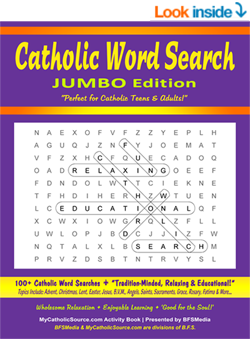
(Original)
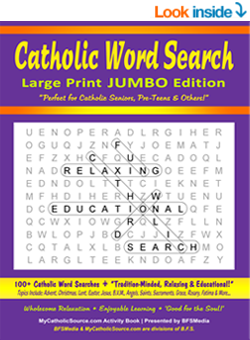
(Large Print Edition)
100+ Catholic Word Searches (Incl. Advent,
Christmas, Lent, Easter, Jesus, B.V.M., Angels, Saints, Sacraments, Grace, Rosary, Fatima, And More...)
"Relaxing, educational, good
for your memory, mind, focus, vocabulary, and good for your soul!"
Get Your Copy Today!
Also
Available...
Catholic
Word Search - Bilingual Edition: Latin / English
Search Words In Latin, Meanings In English
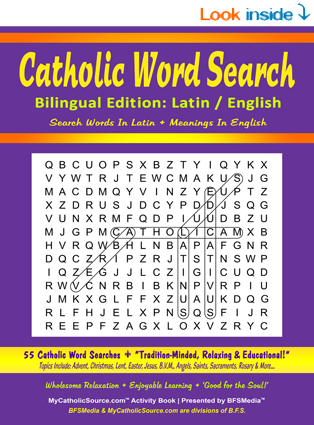
55 Catholic Word Searches ~ "Tradition-Minded,
Relaxing & Educational!"
Topics Include: Advent, Christmas, Lent,
Easter, Jesus, B.V.M., Angels, Saints, Sacraments, Rosary & More...
"Perfect For Catholic
Teens & Adults!" ~ "Great For Home Schoolers!"
Get Your Copy Today!
Why Latin? / Latin Info.
Click link or image above for more information & to purchase.
And...
Catholic
Word Search - Bilingual Edition: French / English
Search Words In French, Meanings In English
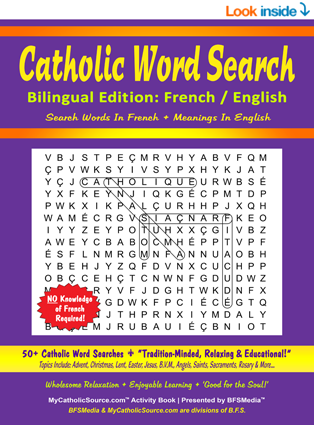
Absolutely NO Knowledge Of
French Is Required!
50+ Catholic Word Searches ~ "Tradition-Minded,
Relaxing & Educational!"
Topics Include: Advent, Christmas, Lent,
Easter, Jesus, B.V.M., Angels, Saints, Sacraments, Rosary & More...
"Perfect For Catholic Teens & Adults!" ~ "Great
For Home Schoolers!"
Fun for any time! Also great for...
* Planning a Catholic pilgrimage to France
* Learning some (or brushing up on some) French
words
* Increasing your French vocabulary
* Adding fun to a homeschool curriculum
* Enjoying a unique challenge, even if you
don't speak a word of French!
Free Sample Here
Get Your Copy Today!
Why Learn French?
Click link or image above for more information & to purchase.
Now Available!
4
Great Inspirational Catholic Coloring Books...


Plus These Handy Coloring Books & Resources...

Lots of Love Coloring Book (Vol.1) - 40 Love-Themed / Affirming Coloring Pages (Easy/Fairly Easy) - "Includes a Variety of Coloring Pages Suitable for Children or Adults!" ~ "Great for Sharing!"

My Colors - Easy & Convenient Color Sample
Sheets ~ Coloring Resources Book: 125+ Assorted Color Sample Sheets - "Perfect
For Testing, Selecting & Organizing Pen, Marker, Pencil or Crayon Colors!"

My Colors 2 - Easy & Flexible Color
Combination Grids ~ Coloring Resources Book: 50+ Color Sample Sheets In 3 Grid
Sizes - "Perfect For Previewing, Testing & Selecting Pen, Marker, Pencil Or
Crayon Color Combinations!"
[Please Note: Proceeds from sales of these books may support My Catholic Source.com]
For More Information & To
Purchase, Click Image(s) Above
Click Here For Coloring Examples
Now Available!
700+ Consoling Thoughts From Holy Scripture
"Inspirational & Uplifting!"
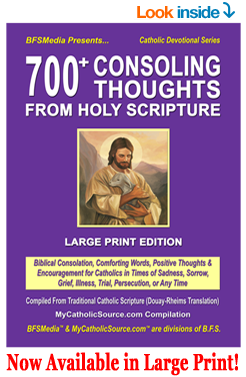
"Some of the most consoling
& comforting words from Holy Scripture, all in one place!"
+ + +
Compiled From Traditional Catholic Scripture
(Douay-Rheims Translation)
Get it today!
+ + +
For More Information & To
Purchase, Click Link Below...
Kindle Version Just $7.99
Notice: Prices are subject to change
without notice and do not include any applicable taxes.
Now Available!
The iStations Book - Stations of the Cross
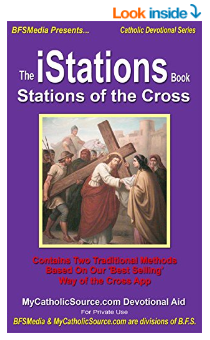
Two Traditional Way of the
Cross Methods for Catholics Based on Our 'Best Selling' App
Features beautiful images, TWO traditional
methods, including a Franciscan method, selected prayers in English & Latin
Get it today!
For More Information & To
Purchase, Click Link Below...
Kindle Version Just $4.99
Notice: Prices are subject to change
without notice and do not include any applicable taxes.
Now Available!
Catholic Annual Prayer Book
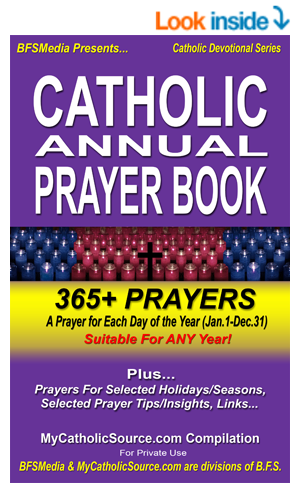
Includes: 365+ Daily Prayers (Jan.-Dec.);
Holiday / Seasonal Prayers; Hundreds of Prayers Indexed by Title;
Nearly 200 Aspirations / Short Prayers; Over 100 Latin Prayers & Aspirations; 500+
Topics for Meditation; Hundreds of Prayer Tips & Insights; And More...
Includes prayers drawn from Holy Scripture, the
liturgy, writings of popes & saints, the Raccolta, the Roman Breviary, the Roman
Missal, etc.
A daily prayer companion for
Catholics that is 'suitable for any year'!
Kindle Version Just $8.99
Notice: Prices are subject to change
without notice and do not include any applicable taxes.
Click Here to Buy
Now Available!
Coloring Book For Catholics: 50+ Latin
Prayers
(Beginning - Intermediate - Advanced)
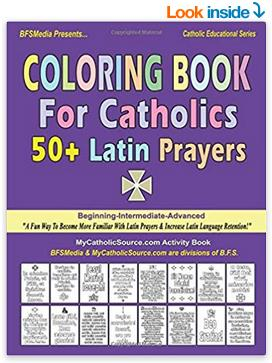
"This 'unique', tradition-minded coloring book
which contains some of the most popular Catholic prayers in Latin is a fun way
to become more familiar with Latin prayers & increase Latin language retention!"
This 'educational & fun' publication is useful
for prayerful relaxation, educational recreation ('learn while you play'),
becoming more familiar with Latin prayers & hundreds of Latin words, learning or
memorizing Latin prayers, increasing Latin retention, and more...
An enjoyable and
instructive tool with respect to Latin (the 'beautiful & majestic language of
heaven' and 'official language of the Church' - a language 'consecrated' by the
inscription on the Cross that helps to foster a universal bond in prayer with
Catholics around the world), this publication is suitable for Catholics of most any
age.
+ + +
"This Catholic coloring book
- which provides hours of wholesome & educational recreation - is so much better
for your soul than television!"
+ + +
Notice: Prices are subject to change
without notice and do not include any applicable taxes.
Click Here to Buy
Now Available!
My Little Latin Mass Coloring Book

25+ Traditional Latin Mass Coloring Images For Children Or Adults [Low
Mass]
"Enjoyable & Educational!"
+ + +
Notice: Prices are subject to change
without notice and do not include any applicable taxes.
Click Here to Buy
Catholic Classics Reprint Now Available!
In Heaven We Know Our Own - Or, Solace for
the Suffering
This 'Catholic Classic', which offers consoling
'proof' that the faithful departed remember, love & care for those in heaven and
for those still remaining on earth, is a "great balm of comfort" to those who
have lost a spouse, child, parent, friend, or other loved one. "A thoughtful
bereavement gift, and a 'must-have' for grieving Catholics!"
Get your copy today!
For More Information & To
Purchase, Click Link Below...
Kindle Version Just $2.99!
Notice: Prices are subject to change
without notice and do not include any applicable taxes.
Now Available!
Setting The Record Straight About Luther
Important Things Catholics Should Know About
The 'Reformer'
Don't miss this
'eye-opening' treatise concerning Martin Luther, the catalyst / leader of the
' Reformation ' (a.k.a. Protestant Rebellion)
Includes: Facts which demonstrate that Luther
was NOT sent by God, Luther received approval of his teaching from Satan,
Luther's misbehavior, some results of Luther's teachings, Luther admits he could
be wrong, and more...
Get your copy today!
For More Information & To
Purchase, Click Link Below...
Kindle Version Just $5.99
Notice: Prices are subject to change
without notice and do not include any applicable taxes.
Now Available!
BIG Book of Latin Activities For Catholics
Beginning - Intermediate (Vol. 1)
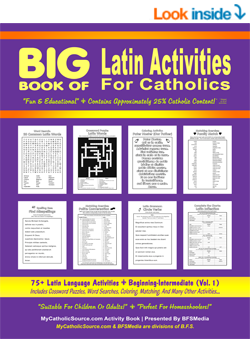
"Suitable For Children Or
Adults!" ~ "Perfect For Home Schoolers!"
+ + +
As many faithful Catholics already know,
the majestic
Latin language – the 'official language' of the Catholic Church –
promotes unity, helps safeguard the purity of doctrine, connects us with
our Catholic ancestors, allows us to pray in "one voice", and even ties
back to the inscription on the Cross which was written in Hebrew, Latin,
and Greek. The Latin language is still used today in the precious
treasure that is the
Traditional Latin ('Tridentine') Mass, in 'everyday speech' (much of
English is derived from Latin), in mottos, in specialized fields, and in
educational endeavors. It has been shown that the study of Latin brings
many benefits. "And, Latin is truly the language of heaven!"
If you enjoy Latin, you may be glad to know that
this full-sized (8.5" x 11"), tradition-minded publication features an
assortment of activity types related to Latin (including: word searches,
crosswords, coloring activities, challenges, fill-ins, spelling bee,
quizzes, unscrambles, true/false, multiple choice, matching, cross-offs,
circling, word associations, translation exercises, and more...), and
treats of various topics (including: common Latin words, Latin language
facts, Latin grammar, nouns & verbs, abbreviations,
phrases / sayings / mottos, prefixes, cardinal numbers, grammatical gender,
inflection, word roots, diacritics / accenting, pronunciation, Latin
prayers / hymns, Scripture verses, Catholic phrases, and more...).
+ + +
" Fun & Educational! "
Get Your Copy Today!
Click Here For More Information & To Purchase
Now Available!
Activity Books For Kindle Scribe

Write-On Books For Scribe!
Click Here For More Information
Try Here For Great Catholic Apps!

My Crucifix
For the iPad®, iPhone®,
and iPod touch®...

For the iPad®...



And Other Great Apps...




More My Catholic Source.com Media: Books & Ebooks
|
|
|
|