|
Reflections: Vatican View (Unity / Truth) |
|
 |
Return
to Vatican View Rflctns. | Vatican View Section
Reflections:
Vatican View Section:
Unity / Truth
Wisdom of the Popes, Saints, Theologians, Other...
|
|
Important Notice: We
make no guarantees regarding any item herein. Use of site is subject to
our terms of use. By using this site you indicate agreement to all
terms. For more terms information, see below and
click here.
|
Click link below or scroll down to view all...
Category |
Quotation |
|
Necessity of a Teaching Authority |
"But everyone can see to how many fallacies an
avenue would be opened up and how many errors would become mixed with
the truth, if it were left solely to the light of reason of each to find
it out, or if it were to be discovered by the private interpretation of
the truth which is revealed." (Pope Pius XI, "Casti Connubii",
1930 A.D.)
"The Church
has but one ruler and one governor,
the invisible one, Christ, whom the eternal Father hath made head over
all the Church, which is his body; the visible one, the Pope, who as the
legitimate successor of Peter, the Prince of the Apostles, fills the
Apostolic chair. It is the unanimous teaching of the Fathers that this
visible head is necessary to establish and preserve unity in the
Church." (Catechism of the Council of Trent)
"In all this confusion of opinion it is some
consolation to Us to see former adherents of rationalism today
frequently desiring to return to the fountain of divinely communicated
truth, and to acknowledge and profess the word of God as contained in
Sacred Scripture as the foundation of religious teaching. But at the
same time it is a matter of regret that not a few of these, the more
firmly they accept the word of God, so much the more do they diminish
the value of human reason, and the more they exalt the authority of God
the Revealer, the more severely do they spurn the teaching office of the
Church, which has been instituted by Christ, Our Lord, to preserve and
interpret divine revelation. This attitude is not only plainly at
variance with Holy Scripture, but is shown to be false by experience
also. For often those who disagree with the true Church complain openly
of their disagreement in matters of dogma and thus unwillingly bear
witness to the necessity of a living Teaching Authority." (Pope
Pius XII, "Humani Generis", 1950)
"But this likewise must be reckoned amongst the
duties of Christians, that they allow themselves to be ruled and
directed by the authority and leadership of bishops, and, above all, of
the Apostolic See. And how fitting it is that this should be so any one
can easily perceive. For the things contained in the divine oracles have
reference to God in part, and in part to man, and to whatever is
necessary for the attainment of his eternal salvation. Now, both these,
that is to say, what we are bound to believe and what we are obliged to
do, are laid down, as we have stated, by the Church using her divine
right, and in the Church by the supreme Pontiff. Wherefore it belongs to
the Pope to judge authoritatively what things the sacred oracles
contain, as well as what doctrines are in harmony, and what in
disagreement, with them; and also, for the same reason, to show forth
what things are to be accepted as right, and what to be rejected as
worthless; what it is necessary to do and what to avoid doing, in order
to attain eternal salvation. For, otherwise, there would be no sure
interpreter of the commands of God, nor would there be any safe guide
showing man the way he should live." (Pope Leo XIII, "Sapientiae
Christianae", 1890 A.D.)
"The heavenly doctrine of Christ, although for
the most part committed to writing by divine inspiration, could not
unite the minds of men if left to the human intellect alone. It would,
for this very reason, be subject to various and contradictory
interpretations. This is so, not only because of the nature of the
doctrine itself and of the mysteries it involves, but also because of
the divergencies of the human mind and of the disturbing element of
conflicting passions. From a variety of interpretations a variety of
beliefs is necessarily begotten; hence come controversies, dissensions
and wrangling such as have arisen in the past, even in the first ages of
the Church. Irenaeus writes of heretics as follows: 'Admitting the
sacred Scriptures they distort the interpretations' (Lib. iii., cap. 12,
n. 12). And Augustine: 'Heresies have arisen, and certain perverse views
ensnaring souls and precipitating them into the abyss only when the
Scriptures, good in themselves, are not properly understood' (In Evang
.Joan., tract xviii., cap. 5, n. I). Besides Holy Writ it was absolutely
necessary to insure this union of men's minds - to effect and preserve
unity of ideas - that there should be another principle. This the wisdom
of God requires: for He could not have willed that the faith should be
one if He did not provide means sufficient for the preservation of this
unity; and this Holy Writ clearly sets forth" (Pope Leo XIII,
"Satis Cognitum", 1896 A.D.)
Also
See: Authority
of the Church | The
Church Rests on St. Peter | Infallibility
| Necessity
of Union With the Roman Pontiff | Obedience
/ Disobedience / Assent | The
Papacy is Indestructible / Perpetual | Papal
Primacy / Supremacy | Praise
of the Papacy | Preservation
of Truth / Unity | The
Visible Church
Note:
Categories are subjective and may overlap. For more items related
to this topic, please review all applicable categories. For more
'Reflections' and for Scripture topics, see links below.
Top |
Reflections: A-Z | Catg.
| Scripture: A-Z |
Catg.
| Help |
|
Preservation
of Truth / Unity |
"Regarding the faith which they uphold, the
ancient Rome has kept a straight course from of old, and still does so,
uniting the whole West by sound teaching, as is just, since she presides
over all and guards the universal divine harmony." (St. Gregory of
Nazianzen, Doctor of the Church, 4th century A.D.)
"Now
if we acknowledge a permanent miracle in the uninterrupted succession of
the Bishops of Rome, in spite of all the revolutions of eighteen
centuries, we acknowledge it to be a still higher prodigy that,
notwithstanding the instability of man's opinions and judgments, the
Chair of Rome has faithfully preserved the truth without the slightest
admixture of error, whereas the sees of Jerusalem, Antioch, Alexandria
and Constantinople were scarcely able to maintain the true Faith for a
few centuries, and have become so frequently those Chairs of pestilence
spoken of by the Royal Prophet (Ps. i I)" (Gueranger)
"To preserve forever in his Church the unity and
doctrine of this faith, Christ chose one of his apostles, Peter, whom he
appointed the Prince of his Apostles, his Vicar on earth, and
impregnable foundation and head of his Church. Surpassing all others
with every dignity of extraordinary authority, power and jurisdiction,
he was to feed the Lord's flock, strengthen his brothers, rule and
govern the universal Church. Christ not only desired that his Church
remain as one and immaculate to the end of the world, and that its unity
in faith, doctrine and form of government remain inviolate. He also
willed that the fullness of dignity, power and jurisdiction, integrity
and stability of faith given to Peter be handed down in its entirety to
the Roman Pontiffs, the successors of this same Peter, who have been
placed on this Chair of Peter in Rome, and to whom has been divinely
committed the supreme care of the Lord's entire flock and the supreme
rule of the Universal Church." (Pope Pius IX, "Amantissimus",
1862)
Also
See: All
Should Agree With the Holy See | Authority
of the Church | The
Church Rests on St. Peter | Infallibility
| Necessity
of a Teaching Authority | Necessity
of Union With the Roman Pontiff | Obedience
/ Disobedience / Assent | The
Papacy is Indestructible / Perpetual | Papal
Duties / Concerns | Papal
Primacy / Supremacy | Papal
Solicitude | Popes
as Preservers of Tradition / Against New Doctrines | Unity
of the Church | The
Visible Church | Vatican
Facts | Pope
/ Papacy (Topical Scripture)
Note:
Categories are subjective and may overlap. For more items related
to this topic, please review all applicable categories. For more
'Reflections' and for Scripture topics, see links below.
Top |
Reflections: A-Z | Catg.
| Scripture: A-Z |
Catg.
| Help |
|
Unity of
the Church |
"The community of believers was of one heart and
mind..." (Acts 4:32)
"Just as God's creature, the sun, is one and the
same the world over, so also does the Church's preaching shine
everywhere to enlighten all men who want to come to the knowledge of
truth." (St. Irenaeus of Lyons)
"But the true church is one, as by unity of
doctrine, so by unity of government, and she is catholic also. Since God
has placed the center and foundation of unity in the chair of Blessed
Peter, she is rightly called the Roman Church, for 'where Peter is,
there is the church.' Wherefore, if anybody wishes to be considered a
real Catholic, he ought to be able to say from his heart the selfsame
words which Jerome addressed to Pope Damasus: 'I, acknowledging no other
leader than Christ, am bound in fellowship with Your Holiness; that is,
with the chair of Peter. I know that the Church was built upon him as
its rock, and that whosoever gathereth not with you, scattereth.'"
(Pope Leo XIII, "Testem Benevolentiae Nostrae", 1899 A.D.)
Also
See: All
Should Agree With the Holy See | The
Church Rests on St. Peter | Infallibility
| National
Churches May Not Be Separate from the Authority of the Roman Pontiff
| Necessity
of a Teaching Authority | Necessity
of Union With the Roman Pontiff | No
Authority Not Emanating From the Holy See / Christ | Obedience
/ Disobedience / Assent | Papal
Duties / Concerns | Papal
Primacy / Supremacy | Preservation
of Truth / Unity | Those
Who Wander From the Apostolic See Wander From the Church | The
Visible Church
Note:
Categories are subjective and may overlap. For more items related
to this topic, please review all applicable categories. For more
'Reflections' and for Scripture topics, see links below.
Top |
Reflections: A-Z | Catg.
| Scripture: A-Z |
Catg.
| Help |
|
Misc. |
"May
the God of endurance and encouragement grant you to think in
harmony with one another, in keeping with Christ Jesus, that with
one accord you may with one voice glorify the God and Father of
our Lord Jesus Christ." (Rom. 15:5-6)
"I
urge you, brothers, to watch out for those who create dissensions
and obstacles, in opposition to the teaching that you learned;
avoid them. For such people do not serve our Lord Christ but their
own appetites, and by fair and flattering speech they deceive the
hearts of the innocent." (Rom. 16:17-18)
"I,
then, a prisoner for the Lord, urge you to live in a manner worthy
of the call you have received, with all humility and gentleness,
with patience, bearing with one another through love, striving to
preserve the unity of the spirit through the bond of peace: one
body and one Spirit, as you were also called to the one hope of
your call; one Lord, one faith, one baptism; one God and Father of
all, who is over all and through all and in all." (Eph.
4:1-6)
"Only, conduct yourselves in a way worthy of the gospel of Christ, so that, whether I come and see you or am absent, I may hear news of you, that you are standing firm in one spirit, with one mind struggling together for the faith of the
gospel" (Phil. 1:27)
"If there is any encouragement in Christ, any solace in love, any participation in the Spirit, any compassion and mercy, complete my joy by being of the same mind, with the same love, united in heart, thinking one thing."
(Phil 2:1-2)
"Therefore, let us be on our guard while the promise of entering into his rest remains, that none of you seem to have failed. For in fact we have received the good news just as they did. But the word that they heard did not profit them, for they were not united in faith with those who listened."
(Heb. 4:1-2)
"I urge you, brothers, in the name of our Lord Jesus Christ, that all of you agree in what you say, and that there be no divisions among you, but that you be united in the same mind and in the same purpose."
(1 Cor. 1:10)
"Do
not be yoked with those who are different, with unbelievers. For
what partnership do righteousness and lawlessness have? Or what
fellowship does light have with darkness? What accord has Christ
with Beliar? Or what has a believer in common with an unbeliever?
What agreement has the temple of God with idols? For we are the
temple of the living God; as God said: 'I will live with them and
move among them, and I will be their God and they shall be my
people. Therefore, come forth from them and be separate,' says the
Lord, 'and touch nothing unclean; then I will receive you and I
will be a father to you, and you shall be sons and daughters to
me, says the Lord Almighty.'" (2 Cor. 6:14-18)
"I
charge you in the presence of God and of Christ Jesus, who will
judge the living and the dead, and by his appearing and his kingly
power: proclaim the word; be persistent whether it is convenient
or inconvenient; convince, reprimand, encourage through all
patience and teaching. For the time will come when people will not
tolerate sound doctrine but, following their own desires and
insatiable curiosity, will accumulate teachers and will stop
listening to the truth and will be diverted to myths. But you, be
self-possessed in all circumstances; put up with hardship; perform
the work of an evangelist; fulfill your ministry." (2 Tm.
4:1-5)
"My
brothers, if anyone among you should stray from the truth and
someone bring him back, he should know that whoever brings back a
sinner from the error of his way will save his soul from death and
will cover a multitude of sins." (Jms. 5:19-20)
"Finally, all of you, be of one mind, sympathetic, loving toward one another, compassionate, humble."
(1 Pt. 3:8)
[Jesus
said:] "I pray for them. I do not pray for the world but for the ones you have given me, because they are yours, and everything of mine is yours and everything of yours is mine, and I have been glorified in them. And now I will no longer be in the world, but they are in the world, while I am coming to you. Holy Father, keep them in your name that you have given me, so that they may be one just as we are. When I was with them I protected them in your name that you gave me, and I guarded them, and none of them was lost except the son of destruction, in order that the scripture might be fulfilled. But now I am coming to you. I speak this in the world so that they may share my joy completely. I gave them your word, and the world hated them, because they do not belong to the world any more than I belong to the world. I do not ask that you take them out of the world but that you keep them from the evil one. They do not belong to the world any more than I belong to the world. Consecrate them in the truth. Your word is truth. As you sent me into the world, so I sent them into the world. And I consecrate myself for them, so that they also may be consecrated in truth.
I pray not only for them, but also for those who will believe in me through their word, so that they may all be one, as you, Father, are in me and I in you, that they also may be in us, that the world may believe that you sent me. And I have given them the glory you gave me, so that they may be one, as we are one, I in them and you in me, that they may be brought to perfection as one, that the world may know that you sent me, and that you loved them even as you loved me. Father, they are your gift to me. I wish that where I am they also may be with me, that they may see my glory that you gave me, because you loved me before the foundation of the world."
(Jn. 17:9-24)
"It
is the Pope, the successor of St. Peter, whose faith cannot fail (Lk.
xxii 32), and whose sovereign word is carried through the whole
world, producing unity of mind and heart, dispelling doubt, and
putting an end to disputation." (Gueranger)
"For, together with the sources of positive
theology God has given to His Church a living Teaching Authority to
elucidate and explain what is contained in the deposit of faith only
obscurely and implicitly. This deposit of faith our Divine Redeemer has
given for authentic interpretation not to each of the faithful, not even
to theologians, but only to the Teaching Authority of the Church."
(Pope Pius XII, "Humani Generis", 1950)
"As from the head and apex of the episcopacy,
that very episcopacy and every authority which bears the same name comes
from here. All waters flow from here as if from their very source, and
they flow uncorrupted from a pure head through the various regions of
the whole world. From here all the churches take what the water worthy
of clean bodies avoids teaching and the people whom, as though fouled in
unpurged filth, the water avoids washing." (Pope Clement XIII,
"A Quo Die", 1758 A.D.)
"Your chief praise is that you have
promoted and sedulously continue to foster the union of your churches
with this chief of churches and with the Vicar of Christ on earth.
Herein, as you rightly confess, is the apex and centre of government, of
teaching and of the priesthood; the source of that unity which Christ
destined for His Church, and which is one of the most striking notes
distinguishing it from all human sects." (Pope Leo XIII, "In
Amplissimo", 1902 A.D.)
"From this it must be clearly understood that
Bishops are deprived of the right and power of ruling, if they
deliberately secede from Peter and his successors; because, by this
secession, they are separated from the foundation on which the whole
edifice must rest. They are therefore outside the edifice itself; and
for this very reason they are separated from the fold, whose leader is
the Chief Pastor; they are exiled from the Kingdom, the keys of which
were given by Christ to Peter alone. These things enable us to see the
heavenly ideal, and the divine exemplar, of the constitution of the
Christian commonwealth, namely: When the Divine founder decreed that the
Church should be one in faith, in government, and in communion, He chose
Peter and his successors as the principle and centre, as it were, of
this unity." (Pope Leo XIII, "Satis Cognitum", 1896 A.D.)
"The eternal Pastor and Bishop of our souls [1
Pet. 2:25], in order to render the saving work of redemption perennial,
willed to build a holy Church, in which, as in the house of the living
God, all the faithful might be contained by the bond of one faith and
charity. Therefore, before His glory was made manifest, 'He asked the
Father, not only for the Apostles but also for those who would believe
through their word in Him, that all might be one, just as the Son
Himself and the Father are one' [John 17:20 f.]. Thus, then, as He sent
the apostles, whom He had selected from the world for Himself, as He
himself had been sent by the Father [John 20:21], so in His Church He
wished the pastors and the doctors to be 'even to the consummation of
the world' [Matt. 28:20]. But, that the episcopacy itself might be one
and undivided, and that the entire multitude of the faithful through
priests closely connected with one another might be preserved in the
unity of faith and communion, placing the blessed Peter over the other
apostles He established in him the perpetual principle and visible
foundation of both unities, upon whose strength the eternal temple might
be erected, and the sublimity of the Church to be raised to heaven might
rise in the firmness of this faith. And, since the gates of hell, to
overthrow the Church, if this were possible, arise from all sides with
ever greater hatred against its divinely established foundation, We
judge it to be necessary for the protection, safety, and increase of the
Catholic flock, with the approbation of the Council, to set forth the
doctrine on the institution, perpetuity, and nature of the Sacred
Apostolic Primacy, in which the strength and solidarity of the whole
Church consist, to be believed and held by all the faithful, according
to the ancient and continual faith of the universal Church, and to
proscribe and condemn the contrary errors, so pernicious to the Lord's
flock." (Vatican Council I, 1870 A.D.)
"It was necessary that a government of this kind,
since it belongs to the constitution and formation of the Church, as its
principal element - that is as the principle of unity and the foundation
of lasting stability - should in no wise come to an end with St. Peter,
but should pass to his successors from one to another. 'There remains,
therefore, the ordinance of truth, and St. Peter, persevering in the
strength of the rock which he had received, hath not abandoned the
government of the Church which had been confided to him' (S. Leo M.
sermo iii., cap. 3). For this reason the Pontiffs who succeed Peter in
the Roman Episcopate receive the supreme power in the church, jure
divino. 'We define' (declare the Fathers of the Council of Florence)
'that the Holy and Apostolic See and the Roman Pontiff hold the primacy
of the Church throughout the whole world: and that the same Roman
Pontiff is the successor of St. Peter, the Prince of the Apostles, and
the true Vicar of Christ, the head of the whole Church, and the father
and teacher of all Christians; and that full power was given to him, in
Blessed Peter, by our Lord Jesus Christ to feed, to rule, and to govern
the universal Church, as is also contained in the acts of oecumenical
councils and in the sacred canons' (Conc. Florentinum). Similarly the
Fourth Council of Lateran declares: 'The Roman Church, as the mother and
mistress of all the faithful, by the will of Christ obtains primacy of
jurisdiction over all other Churches.' These declarations were preceded
by the consent of antiquity which ever acknowledged, without the
slightest doubt or hesitation, the Bishops of Rome, and revered them, as
the legitimate successors of St. Peter. Who is unaware of the many and
evident testimonies of the holy Fathers which exist to this effect? Most
remarkable is that of St. Irenaeus who, referring to the Roman Church,
says: 'With this Church, on account of its preeminent authority, it is
necessary that every Church should be in concord' (Contra Haereses, lib.
iii., cap. 3, n. 2); and St. Cyprian also says of the Roman Church, that
'it is the root and mother of the Catholic Church, the chair of Peter,
and the principal Church whence sacerdotal unity has its source' (Ep.
xlviii., ad Cornelium, n. 3. and Ep. liac., ad eundem, n. 14). He calls
it the chair of Peter because it is occupied by the successor of Peter:
he calls it the principal Church, on account of the primacy conferred on
Peter himself and his legitimate successors; and the source of unity,
because the Roman Church is the efficient cause of unity in the
Christian commonwealth." (Pope Leo XIII, "Satis Cognitum",
1896 A.D.) Also
See: All
Should Agree With the Holy See | Infallibility
| Necessity
of Union With the Roman Pontiff | Obedience
/ Disobedience / Assent | Papal
Primacy / Supremacy | The
Visible Church | Truth
(Topical Scripture) | Heresy
(Topical Scripture)
Note:
Categories are subjective and may overlap. For more items related
to this topic, please review all applicable categories. For more
'Reflections' and for Scripture topics, see links below.
Top |
Reflections: A-Z | Catg.
| Scripture: A-Z |
Catg.
| Help |
Important
Notice: Items herein are not comprehensive. Items herein are
categorized subjectively and may overlap. We make no
guarantees concerning any item herein. We may change punctuation,
capitalization, shorten items, etc. and we caution that items
herein may be out of context. We recommend reading items in full
context in appropriate Catholic materials. Users are reminded that even saints
and popes (when not speaking ex cathedra) are not infallible.
Inclusion of any item does not necessarily imply our endorsement
or agreement. Consult appropriate, competent Church
authorities for assistance in interpreting / applying items
herein. Interpretation and application of items herein should not
be contrary to the perennial, official teaching of the Roman
Catholic Church. Do not take items out of context. Do not inflict
harm on yourself or others, break laws, take unsuitable /
incautious or inappropriate / drastic actions, or take figurative
items literally. We are not responsible for any interpretation /
misinterpretation, application / misapplication, use / misuse,
etc. of any item. Use of site is
at your own risk and is subject to our terms of use.
Click
here for more important terms/information
We make no guarantees
regarding any item herein. By using this site you agree to all terms. For terms
information, see "Important Notice" above and click
here.
|
|
|
|
|
|
|
|
|
Catholic Books & Ebooks
Click Here
|
|
Reflections (Wisdom From Popes & Saints)
Click Here
|
|
'Quick Help' Pages
Click Here
|
|
Need Help?
'Live Chat'
Click Here
|

Home
MCS Daily Digest
Quick Guide to This Site
What's New
Reception Desk
Notices
Topic Pages
'Quick Help' Pages
Books / Ebooks |
Kindle Scribe Books
Apps
Reflections
Help |
'Live Chat'
Coming Soon
Featured Sections
URL Shortcuts
Calendar
Goals / Purpose
This site is really free?
How can I add a "post" here?
Mission Statement
Privacy Statement
Imprimatur Information
Terms of Use
by using this site, you agree to all terms
MCS Directory
Community Center
Commercial Areas
Non-Catholics
About Us
FAQs
Tell a Friend
Invite a Business
Link to Us
My Catholic Source.com Blog & RSS Feed Info.
Third Party Programs
Awards
Feedback
Contact Us
This site powered by
bfsnet.com

|
|
Now Available!
Catholic Word Search - JUMBO Edition
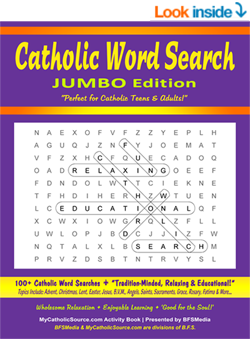
(Original)
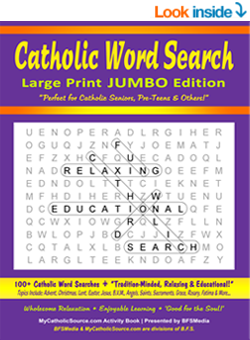
(Large Print Edition)
100+ Catholic Word Searches (Incl. Advent,
Christmas, Lent, Easter, Jesus, B.V.M., Angels, Saints, Sacraments, Grace, Rosary, Fatima, And More...)
"Relaxing, educational, good
for your memory, mind, focus, vocabulary, and good for your soul!"
Get Your Copy Today!
Also
Available...
Catholic
Word Search - Bilingual Edition: Latin / English
Search Words In Latin, Meanings In English
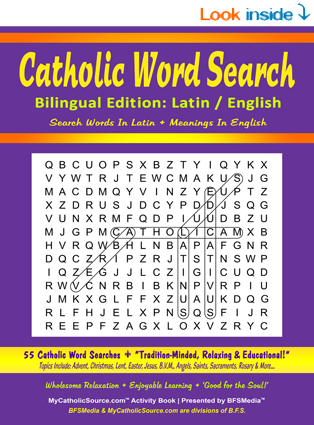
55 Catholic Word Searches ~ "Tradition-Minded,
Relaxing & Educational!"
Topics Include: Advent, Christmas, Lent,
Easter, Jesus, B.V.M., Angels, Saints, Sacraments, Rosary & More...
"Perfect For Catholic
Teens & Adults!" ~ "Great For Home Schoolers!"
Get Your Copy Today!
Why Latin? / Latin Info.
Click link or image above for more information & to purchase.
And...
Catholic
Word Search - Bilingual Edition: French / English
Search Words In French, Meanings In English
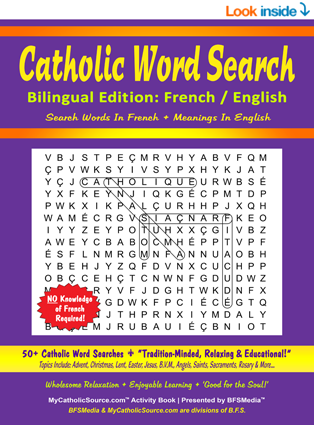
Absolutely NO Knowledge Of
French Is Required!
50+ Catholic Word Searches ~ "Tradition-Minded,
Relaxing & Educational!"
Topics Include: Advent, Christmas, Lent,
Easter, Jesus, B.V.M., Angels, Saints, Sacraments, Rosary & More...
"Perfect For Catholic Teens & Adults!" ~ "Great
For Home Schoolers!"
Fun for any time! Also great for...
* Planning a Catholic pilgrimage to France
* Learning some (or brushing up on some) French
words
* Increasing your French vocabulary
* Adding fun to a homeschool curriculum
* Enjoying a unique challenge, even if you
don't speak a word of French!
Free Sample Here
Get Your Copy Today!
Why Learn French?
Click link or image above for more information & to purchase.
Now Available!
4
Great Inspirational Catholic Coloring Books...

Plus These Handy Coloring Books & Resources...

Lots of Love Coloring Book (Vol.1) - 40 Love-Themed / Affirming Coloring Pages (Easy/Fairly Easy) - "Includes a Variety of Coloring Pages Suitable for Children or Adults!" ~ "Great for Sharing!"

My Colors - Easy & Convenient Color Sample
Sheets ~ Coloring Resources Book: 125+ Assorted Color Sample Sheets - "Perfect
For Testing, Selecting & Organizing Pen, Marker, Pencil or Crayon Colors!"

My Colors 2 - Easy & Flexible Color
Combination Grids ~ Coloring Resources Book: 50+ Color Sample Sheets In 3 Grid
Sizes - "Perfect For Previewing, Testing & Selecting Pen, Marker, Pencil Or
Crayon Color Combinations!"
[Please Note: Proceeds from sales of these books may support My Catholic Source.com]
For More Information & To
Purchase, Click Image(s) Above
Click Here For Coloring Examples
Now Available!
700+ Consoling Thoughts From Holy Scripture
"Inspirational & Uplifting!"
"Some of the most consoling
& comforting words from Holy Scripture, all in one place!"
+ + +
Compiled From Traditional Catholic Scripture
(Douay-Rheims Translation)
Get it today!
+ + +
For More Information & To
Purchase, Click Link Below...
Kindle Version Just $7.99
Notice: Prices are subject to change
without notice and do not include any applicable taxes.
Now Available!
The iStations Book - Stations of the Cross
Two Traditional Way of the
Cross Methods for Catholics Based on Our 'Best Selling' App
Features beautiful images, TWO traditional
methods, including a Franciscan method, selected prayers in English & Latin
Get it today!
For More Information & To
Purchase, Click Link Below...
Kindle Version Just $4.99
Notice: Prices are subject to change
without notice and do not include any applicable taxes.
Now Available!
Catholic Annual Prayer Book
Includes: 365+ Daily Prayers (Jan.-Dec.);
Holiday / Seasonal Prayers; Hundreds of Prayers Indexed by Title;
Nearly 200 Aspirations / Short Prayers; Over 100 Latin Prayers & Aspirations; 500+
Topics for Meditation; Hundreds of Prayer Tips & Insights; And More...
Includes prayers drawn from Holy Scripture, the
liturgy, writings of popes & saints, the Raccolta, the Roman Breviary, the Roman
Missal, etc.
A daily prayer companion for
Catholics that is 'suitable for any year'!
Kindle Version Just $8.99
Notice: Prices are subject to change
without notice and do not include any applicable taxes.
Click Here to Buy
Now Available!
Coloring Book For Catholics: 50+ Latin
Prayers
(Beginning - Intermediate - Advanced)
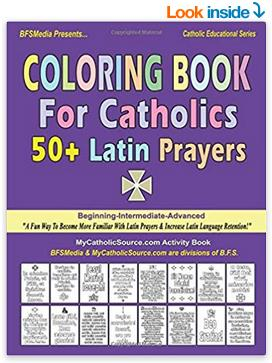
"This 'unique', tradition-minded coloring book
which contains some of the most popular Catholic prayers in Latin is a fun way
to become more familiar with Latin prayers & increase Latin language retention!"
This 'educational & fun' publication is useful
for prayerful relaxation, educational recreation ('learn while you play'),
becoming more familiar with Latin prayers & hundreds of Latin words, learning or
memorizing Latin prayers, increasing Latin retention, and more...
An enjoyable and
instructive tool with respect to Latin (the 'beautiful & majestic language of
heaven' and 'official language of the Church' - a language 'consecrated' by the
inscription on the Cross that helps to foster a universal bond in prayer with
Catholics around the world), this publication is suitable for Catholics of most any
age.
+ + +
"This Catholic coloring book
- which provides hours of wholesome & educational recreation - is so much better
for your soul than television!"
+ + +
Notice: Prices are subject to change
without notice and do not include any applicable taxes.
Click Here to Buy
Now Available!
My Little Latin Mass Coloring Book

25+ Traditional Latin Mass Coloring Images For Children Or Adults [Low
Mass]
"Enjoyable & Educational!"
+ + +
Notice: Prices are subject to change
without notice and do not include any applicable taxes.
Click Here to Buy
Catholic Classics Reprint Now Available!
In Heaven We Know Our Own - Or, Solace for
the Suffering
This 'Catholic Classic', which offers consoling
'proof' that the faithful departed remember, love & care for those in heaven and
for those still remaining on earth, is a "great balm of comfort" to those who
have lost a spouse, child, parent, friend, or other loved one. "A thoughtful
bereavement gift, and a 'must-have' for grieving Catholics!"
Get your copy today!
For More Information & To
Purchase, Click Link Below...
Kindle Version Just $2.99!
Notice: Prices are subject to change
without notice and do not include any applicable taxes.
Now Available!
Setting The Record Straight About Luther
Important Things Catholics Should Know About
The 'Reformer'
Don't miss this
'eye-opening' treatise concerning Martin Luther, the catalyst / leader of the
' Reformation ' (a.k.a. Protestant Rebellion)
Includes: Facts which demonstrate that Luther
was NOT sent by God, Luther received approval of his teaching from Satan,
Luther's misbehavior, some results of Luther's teachings, Luther admits he could
be wrong, and more...
Get your copy today!
For More Information & To
Purchase, Click Link Below...
Kindle Version Just $5.99
Notice: Prices are subject to change
without notice and do not include any applicable taxes.
Now Available!
BIG Book of Latin Activities For Catholics
Beginning - Intermediate (Vol. 1)
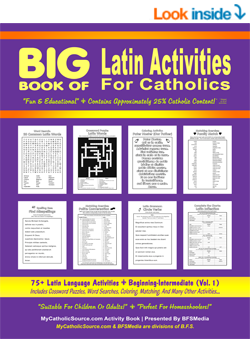
"Suitable For Children Or
Adults!" ~ "Perfect For Home Schoolers!"
+ + +
As many faithful Catholics already know,
the majestic
Latin language – the 'official language' of the Catholic Church –
promotes unity, helps safeguard the purity of doctrine, connects us with
our Catholic ancestors, allows us to pray in "one voice", and even ties
back to the inscription on the Cross which was written in Hebrew, Latin,
and Greek. The Latin language is still used today in the precious
treasure that is the
Traditional Latin ('Tridentine') Mass, in 'everyday speech' (much of
English is derived from Latin), in mottos, in specialized fields, and in
educational endeavors. It has been shown that the study of Latin brings
many benefits. "And, Latin is truly the language of heaven!"
If you enjoy Latin, you may be glad to know that
this full-sized (8.5" x 11"), tradition-minded publication features an
assortment of activity types related to Latin (including: word searches,
crosswords, coloring activities, challenges, fill-ins, spelling bee,
quizzes, unscrambles, true/false, multiple choice, matching, cross-offs,
circling, word associations, translation exercises, and more...), and
treats of various topics (including: common Latin words, Latin language
facts, Latin grammar, nouns & verbs, abbreviations,
phrases / sayings / mottos, prefixes, cardinal numbers, grammatical gender,
inflection, word roots, diacritics / accenting, pronunciation, Latin
prayers / hymns, Scripture verses, Catholic phrases, and more...).
+ + +
" Fun & Educational! "
Get Your Copy Today!
Click Here For More Information & To Purchase
Now Available!
Activity Books For Kindle Scribe

Write-On Books For Scribe!
Click Here For More Information
Try Here For Great Catholic Apps!
My Crucifix
For the iPad®, iPhone®,
and iPod touch®...

For the iPad®...


And Other Great Apps...




More My Catholic Source.com Media: Books & Ebooks
|
|
|
|